Doctor Review Analysis: Mining Healthgrades, Vitals & RateMDs for Patient Intelligence
A healthcare-specific guide to analyzing patient reviews across Healthgrades, Vitals, RateMDs, Zocdoc, and Google. Covers HIPAA-compliant response frameworks, patient sentiment themes, competitive benchmarking between practices, and correlation with CMS star ratings.
A single negative review on Healthgrades can cost a medical practice between $15,000 and $30,000 in lost patient lifetime value. That number comes from a 2025 MGMA study that tracked patient acquisition rates against online review profiles — and it accounts for the fact that a patient who chooses a different provider because of a negative review also takes their family members, referrals, and decades of ongoing care with them.
For physicians and practice administrators, this makes review analysis not a marketing exercise but a clinical operations concern. What patients say in their reviews reveals systemic issues with scheduling, wait times, bedside manner, front desk interactions, billing transparency, and care coordination — the same operational dimensions that drive patient satisfaction scores, CMS star ratings, and ultimately reimbursement rates.
The dynamic intensifies for urgent-care specialties. A patient searching for emergency dentists in New York at 9pm on a Saturday typically reads two or three recent reviews before calling rather than doing full research, which means a single unresolved complaint from last month can redirect weekend patient flow before the practice opens on Monday. The compressed decision window in urgent care makes review recency and response posture significantly more consequential than in routine primary-care specialties.
Yet most medical practices approach reviews reactively: someone checks Google every few weeks, maybe responds to the most egregious complaints, and hopes for the best. Systematic review analysis — structured, ongoing, multi-platform — remains rare in healthcare, which means it is also a significant competitive advantage for the practices that adopt it.
This guide covers review analysis specifically for medical practices. We address the major healthcare review platforms, HIPAA-compliant response frameworks, the patient sentiment themes that matter most, competitive benchmarking between practices, and the growing connection between online reviews and CMS quality metrics.
The Healthcare Review Platform Landscape
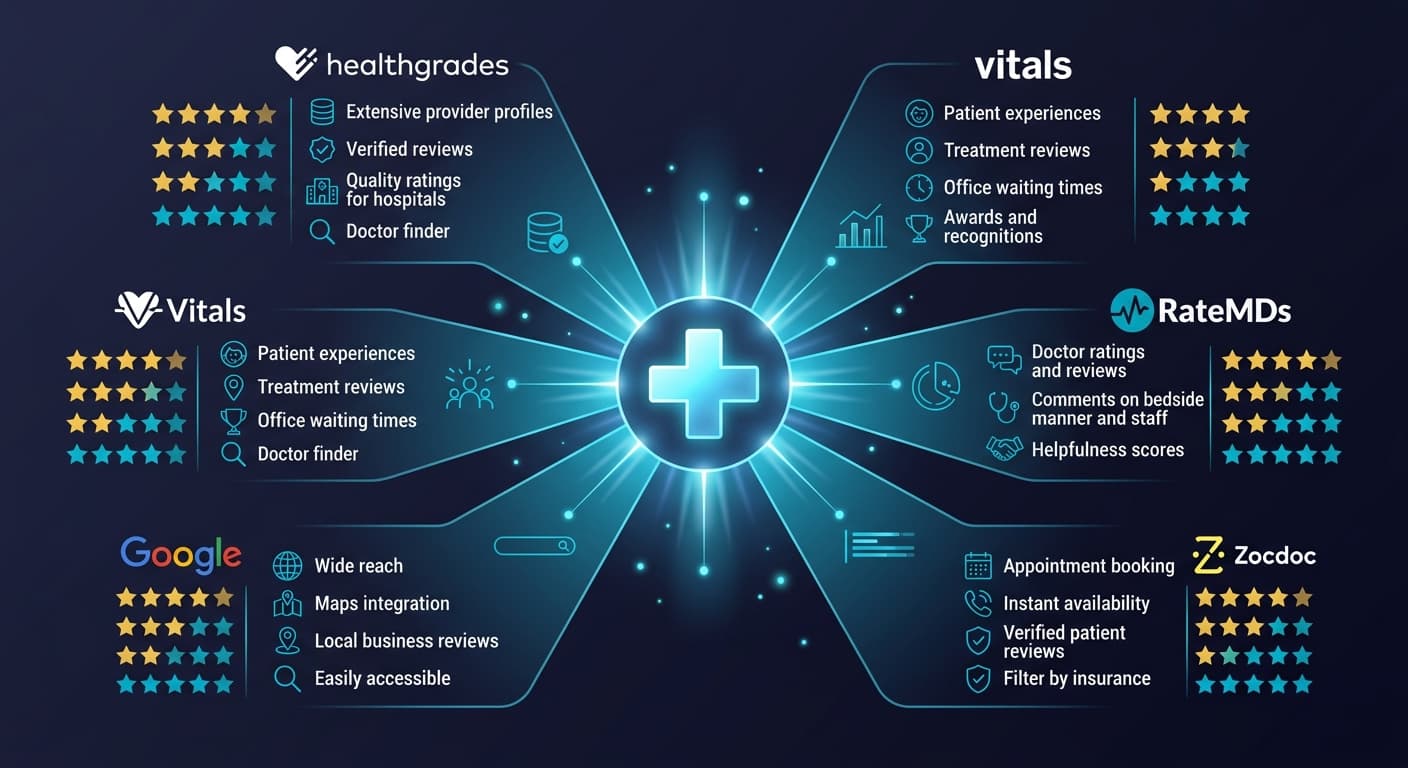
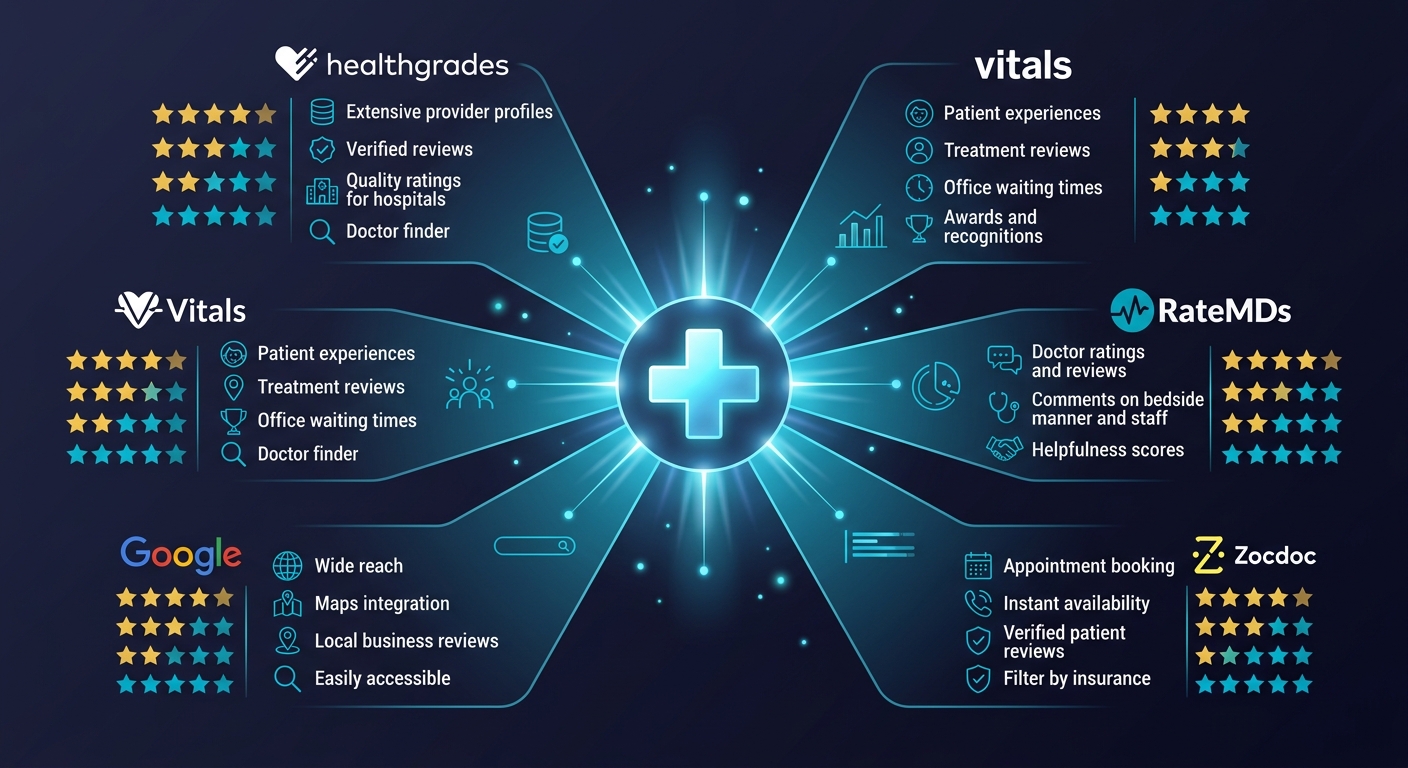
Healthcare reviews are fragmented across more platforms than almost any other industry. A single practice might have reviews on six or more sites, each with different audiences, review formats, and algorithmic weight.
Platform-by-Platform Breakdown
Healthgrades is the largest healthcare-specific review platform with profiles for over 3 million providers. Reviews include an overall rating plus structured sub-ratings for trust, explains conditions well, answers questions, and time spent with patient. Healthgrades reviews tend to be more detailed than other platforms because the review form prompts patients for specific feedback dimensions.
Vitals focuses on patient experience metrics and displays average wait times, office environment ratings, and staff friendliness alongside traditional star ratings. The platform's "patients' choice" and "top doctor" badges carry weight with health-conscious consumers researching providers.
RateMDs has a strong presence in the US and Canada, with reviews organized around four categories: staff, punctuality, helpfulness, and knowledge. The dual scoring (overall rating plus category breakdowns) provides useful analytical granularity.
Zocdoc is both a review platform and an appointment booking engine. Reviews on Zocdoc are exclusively from patients who booked through the platform, making them verified. Because Zocdoc is a direct patient acquisition channel, review management here has an immediate impact on appointment volume.
Google Business Profile is technically not healthcare-specific, but it is the single most visible review surface for any medical practice. More patients find their doctor through Google Maps and local search than through any healthcare-specific platform.
WebMD acquired Vitals and now integrates physician reviews into its health information platform, reaching millions of health-seeking consumers monthly.
Where Patients Actually Look
| Platform | Monthly Visitors (US) | Patient Decision Impact | Review Depth | Verification Level |
|---|---|---|---|---|
| 5+ billion searches/mo | Very High (often first touchpoint) | Low-Medium | None | |
| Healthgrades | 50+ million | High (healthcare-specific research) | High | Moderate |
| Zocdoc | 25+ million | Very High (directly tied to booking) | Medium-High | High (booking verified) |
| Vitals/WebMD | 40+ million (combined) | Medium-High | Medium | Low-Moderate |
| RateMDs | 10+ million | Medium | Medium | Low |
| Yelp | 30+ million | Medium (used for specialists, dentists) | Medium-High | None |
The key insight: patients typically check 2-3 platforms before selecting a provider. A practice with strong Google reviews but poor Healthgrades reviews still loses patients — the negative platform creates doubt even when others look positive.
Patient Sentiment Themes: What Actually Matters
Patient reviews cover a predictable set of themes, but the weight of each theme varies significantly by specialty and practice type.
The Six Core Patient Review Themes
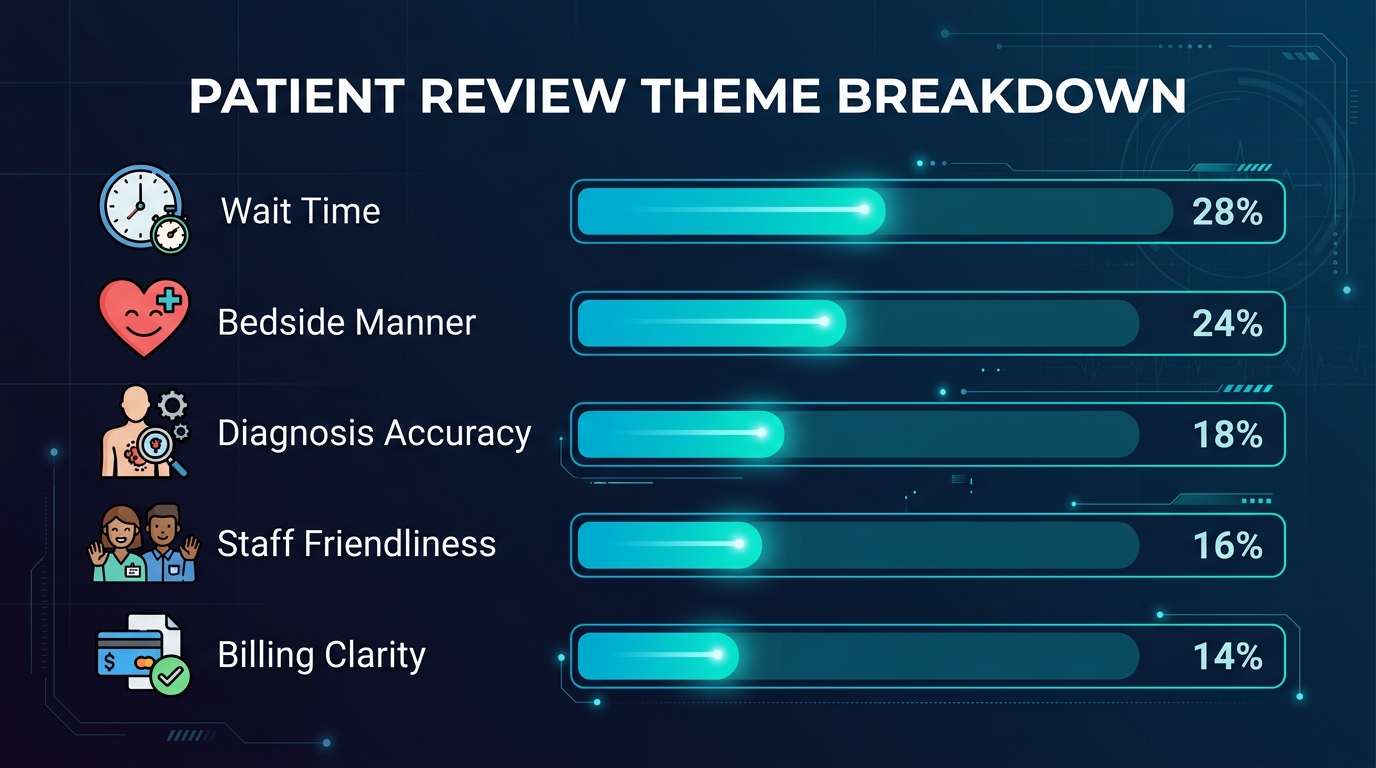
1. Wait Time and Scheduling This is the number one complaint across every healthcare review platform. Patients who wait more than 20 minutes past their appointment time are 3x more likely to leave a negative review, and the review almost always mentions the wait regardless of how good the clinical care was. Scheduling-related reviews include difficulty getting appointments, online booking failures, phone hold times, and last-minute cancellations.
2. Bedside Manner and Communication The second most impactful theme. Patients want to feel heard, respected, and informed. Reviews about bedside manner use language like "rushed," "didn't listen," "made me feel dismissed," or conversely "took time to explain," "answered all my questions," "made me feel comfortable." This theme has the highest correlation with overall star rating — a doctor with excellent bedside manner reviews can overcome moderate wait time complaints, but the reverse is rarely true.
3. Diagnosis and Treatment Quality Patients cannot evaluate clinical accuracy the way a peer reviewer would, but they review perceived diagnostic thoroughness, willingness to run tests, explanation of diagnosis in understandable terms, treatment effectiveness, and follow-up care. Reviews that mention feeling "brushed off" or "not taken seriously" often indicate perceived diagnostic shortcomings.
4. Staff and Front Desk Experience The front desk is the first and last touchpoint of every visit, and negative staff interactions generate disproportionate review anger. Rudeness, billing confusion, insurance complications, phone manners, and appointment management are common themes. Notably, a rude front desk interaction can generate a 1-star review even when the clinical care was excellent.
5. Billing and Insurance Surprise billing, unclear cost communication, insurance claim denials, and aggressive collections practices generate some of the most emotionally charged negative reviews. This theme has grown steadily since the No Surprises Act, with patients becoming more aware of their billing rights and more vocal when practices fall short.
6. Facility and Environment Cleanliness, modernity, comfort, parking, accessibility, and COVID-era safety protocols. This theme rarely drives 5-star reviews on its own, but a dirty or outdated facility generates negative reviews that disproportionately deter new patients. Post-pandemic, cleanliness mentions in healthcare reviews increased by 340% and have not returned to pre-pandemic levels.
Theme Weight by Specialty
| Specialty | Highest-Weight Theme | Second Theme | Unique Theme |
|---|---|---|---|
| Primary Care | Wait time | Bedside manner | Continuity of care |
| Orthopedics | Treatment outcomes | Wait time | Surgical results and recovery |
| Dermatology | Wait time | Cosmetic results | Before/after expectations |
| Pediatrics | Bedside manner (with children) | Wait time | Child comfort and anxiety management |
| OB/GYN | Bedside manner | Scheduling | Pregnancy care continuity |
| Dentistry | Pain management | Cost transparency | Upselling perception |
| Mental Health | Listening and empathy | Scheduling availability | Appointment length adequacy |
| Cardiology | Diagnosis thoroughness | Communication of results | Test and procedure explanations |
The HIPAA-Compliant Response Framework
Responding to patient reviews is one of the most legally sensitive areas in healthcare marketing. HIPAA prohibits the disclosure of protected health information (PHI), which means you cannot confirm or deny that someone is a patient, discuss their treatment, or reference any clinical details — even if the reviewer has already disclosed this information in their review.
"The patient can say anything they want about their care in a public review. The practice cannot confirm, deny, or elaborate on any clinical detail — even to correct factual errors. This asymmetry makes HIPAA-compliant review response a unique challenge."
What You CAN Say
- General statements about your practice values and standards
- Invitations to contact the office directly for resolution
- Expressions of concern about the reported experience
- General descriptions of your policies (not as applied to this specific patient)
- Gratitude for positive feedback (without confirming patient status)
What You CANNOT Say
- Confirmation that the reviewer was a patient
- Any reference to the reviewer's diagnosis, treatment, or medical history
- Specific dates of visits or procedures
- Details about the reviewer's insurance or billing situation
- Names of staff members who treated the reviewer
Response Templates
For negative reviews (HIPAA-compliant):
"Thank you for taking the time to share your feedback. We take all patient experiences seriously and are committed to providing the highest standard of care. We would welcome the opportunity to discuss your concerns privately. Please contact our patient relations team at [phone/email] so we can address your experience directly."
For positive reviews (HIPAA-compliant):
See What Your Reviews Really Say
Paste any product URL and get an AI-powered SWOT analysis in under 60 seconds.
Try It Free →"Thank you for your kind words. Our team is dedicated to providing a comfortable and caring experience for everyone we serve. We appreciate you sharing your feedback."
Notice that neither response confirms the reviewer was a patient. This is intentional and legally necessary.
The Private Resolution Pathway
The most effective strategy for negative healthcare reviews is to move the conversation offline:
- Post the HIPAA-compliant public response within 24-48 hours
- Have your patient relations or office manager attempt to identify the patient internally (without confirming externally)
- Contact the patient directly to discuss their concerns
- Resolve the issue through your internal patient satisfaction process
- After resolution, it is appropriate (but not required) to gently ask if they would consider updating their review
This offline resolution approach complies with HIPAA while still addressing patient concerns substantively.
Competitive Benchmarking Between Practices
Review-based competitive analysis is especially powerful for medical practices because it reveals patient experience dimensions that clinical quality metrics miss.
Building Your Competitive Benchmark
Step 1: Identify your comparison set. Select 3-5 practices in your specialty and geographic area. Include the practice you hear patients mention most often ("I was also considering Dr. Smith") and the practice with the highest online visibility.
Step 2: Collect baseline metrics.
| Metric | Your Practice | Competitor A | Competitor B | Competitor C |
|---|---|---|---|---|
| Google Rating | 4.3 | 4.6 | 4.1 | 4.5 |
| Google Review Count | 87 | 245 | 52 | 189 |
| Healthgrades Rating | 4.0 | 4.4 | 3.8 | 4.2 |
| Healthgrades Review Count | 34 | 98 | 21 | 67 |
| Zocdoc Rating | 4.5 | 4.7 | 4.3 | 4.4 |
| Top Positive Theme | Bedside manner | Short wait times | Thorough diagnosis | Staff friendliness |
| Top Negative Theme | Wait time | Hard to reach by phone | Outdated facility | Billing confusion |
Step 3: Identify strategic gaps. Look for dimensions where competitors are weak and you can be strong. In the example above, no competitor excels at both bedside manner and short wait times — that combination would be a powerful differentiator.
Step 4: Track quarterly. Run the same analysis every quarter using Sentimyne to monitor whether your operational changes are improving your competitive position. The free tier (2 analyses/month) covers a monthly check on your practice and one competitor. Pro ($29/month) lets you monitor all competitors and all platforms continuously.
The CMS Star Rating Connection
For practices that participate in Medicare, there is a growing correlation between online review themes and CMS star ratings. The CMS patient experience measures (derived from CAHPS surveys) evaluate many of the same dimensions that patients review online:
- Communication with doctors (maps to bedside manner reviews)
- Communication about medicines (maps to treatment explanation reviews)
- Responsiveness of hospital staff (maps to staff and front desk reviews)
- Communication about discharge (maps to follow-up care reviews)
- Overall rating of hospital (maps to overall star rating)
Practices that systematically improve the themes identified in their online reviews often see corresponding improvements in CAHPS scores — and by extension, CMS star ratings and value-based reimbursement. Review analysis is not just a marketing tool; it is a quality improvement tool that happens to also drive patient acquisition.
Building a Healthcare Review Monitoring System
Given the multi-platform fragmentation and HIPAA constraints, medical practices need a structured monitoring system:
Daily (5 minutes): Check Google and Zocdoc for new reviews. These platforms drive the most immediate patient decisions. Flag any negative reviews for same-day response.
Weekly (15 minutes): Check Healthgrades, Vitals, and RateMDs. Respond to all reviews requiring a response. Log new review themes in your tracking system.
Monthly (45 minutes): Run a comprehensive analysis across all platforms using Sentimyne. Compare theme trends to the previous month. Share the analysis summary with your practice administrator and lead physicians. Identify one operational improvement to implement based on review data.
Quarterly (2 hours): Full competitive benchmarking. Compare your multi-platform profile to 3-5 competitors. Correlate review themes with patient satisfaction survey data and CAHPS scores. Present findings to the practice leadership team with specific operational recommendations.
HIPAA-Compliant Review Analysis Tools
When choosing a review analysis tool for healthcare, ensure it:
- Does not require you to upload patient data — only processes publicly available review text
- Does not store PHI or associate review analysis with patient records
- Provides output that can be shared internally without creating a HIPAA exposure
- Supports the healthcare-specific platforms (Healthgrades, Vitals, RateMDs, Zocdoc)
Sentimyne meets these criteria because it analyzes publicly available review text from platform URLs — no patient data is uploaded, stored, or processed. The SWOT output contains thematic analysis, not patient-identifiable information.
For related healthcare reputation strategies, see our guides on how to respond to negative reviews with a section on industry-specific frameworks, and our review analysis for small businesses guide which covers multi-location healthcare practices. For competitive intelligence methods, see competitive intelligence from reviews.
Frequently Asked Questions
Can doctors respond to negative reviews without violating HIPAA?
Yes, but the response must be carefully crafted. Doctors and practice staff can post a general response that does not confirm or deny the reviewer's status as a patient, does not reference any clinical details, and does not discuss specific dates, treatments, or diagnoses. The safest approach is a brief, empathetic response that invites the reviewer to contact the practice directly for resolution. Many healthcare attorneys recommend having a single approved response template that all staff use, reviewed by legal counsel, to eliminate the risk of accidental PHI disclosure.
Which healthcare review platform matters most for patient acquisition?
Google Business Profile is the single highest-impact platform because it appears in local search results, Google Maps, and "near me" queries — which is how most patients begin their provider search. However, health-conscious patients who research thoroughly typically check Healthgrades or Zocdoc as a secondary source. For specialists, Healthgrades carries particular weight because patients searching for specific conditions or procedures often land on Healthgrades profile pages through organic search. The recommended approach is to prioritize Google for visibility and Healthgrades for credibility.
How do patient reviews correlate with CMS star ratings?
The correlation is growing stronger as both systems measure similar patient experience dimensions. The CAHPS survey — which feeds CMS star ratings — evaluates communication, responsiveness, and overall satisfaction. These same themes dominate online patient reviews. Practices that improve themes identified in their online reviews (particularly wait time, communication, and staff interactions) consistently see corresponding improvements in CAHPS scores within 6-12 months. This makes review analysis a leading indicator of CMS quality metrics — you can identify and fix patient experience issues through reviews months before they appear in formal survey data.
How many reviews does a medical practice need to be competitive?
The benchmark varies by market size and specialty. In most metropolitan areas, practices with 50 or more Google reviews and 20 or more Healthgrades reviews are considered well-established. However, the competitive threshold is relative — if your primary competitors have 200 Google reviews and you have 30, you are at a significant disadvantage regardless of absolute numbers. Review velocity (new reviews per month) matters as much as total count because recent reviews carry more weight in both patient perception and platform algorithms. Aim for at least 3-5 new reviews per month across your priority platforms.
What are the most common mistakes medical practices make with review management?
The five most common mistakes are: (1) not monitoring healthcare-specific platforms like Healthgrades and Vitals while only watching Google, (2) violating HIPAA in review responses by confirming patient status or referencing clinical details, (3) ignoring negative reviews entirely instead of posting a professional response, (4) asking patients for reviews in a way that feels transactional or coercive, and (5) failing to connect review themes to internal quality improvement processes. The last mistake is the most costly because it means the practice keeps generating the same negative themes month after month without ever addressing the root cause.
Ready to try AI-powered review analysis?
Get 2 free SWOT reports per month. No credit card required.
Start FreeRelated Articles
Learn how to analyze patient reviews for healthcare organizations. Covers HIPAA considerations, key review platforms, top patient complaint themes, multi-provider monitoring, CMS star ratings, and using sentiment analysis for quality improvement.
Discord Community Sentiment Analysis: Mining Member Feedback From Private CommunitiesDiscord communities are invisible to traditional review platforms. Learn how to systematically extract and analyze member sentiment from channels to detect engagement churn, identify friction points, and drive community growth.
Luxury Brand Review Analysis: Understanding High-End Customer Expectations and FeedbackLuxury brands operate with different customer expectations. Learn how to analyze reviews on specialty platforms, separate outcome from process feedback, and detect quality deterioration in high-margin segments.