Yelp Review Analysis: Deep Intelligence for Local & Service Businesses
Master Yelp review analysis for local and service businesses. Covers Yelp's recommendation algorithm, filtered reviews, elite reviewer impact, competitive intelligence extraction, and sentiment analysis techniques for restaurants, services, and retail.
Yelp processes over 265 million cumulative reviews across local businesses worldwide. Unlike Google or Facebook, where reviews are one feature among dozens, Yelp's entire business model revolves around reviews. That singular focus has produced a platform with unique characteristics — an aggressive recommendation algorithm, a tiered reviewer ecosystem, and a filtered review system that hides a significant percentage of submitted feedback from public view.
For local and service businesses, Yelp reviews carry disproportionate weight. A 2025 BrightLocal study found that 72% of consumers who search for local services on Yelp take action within 24 hours — calling, visiting, or making a purchase. The conversion intent on Yelp is materially higher than on general search platforms because people go to Yelp specifically to make decisions.
Yet most businesses treat Yelp reviews the same way they treat reviews on any other platform: glance at the star rating, maybe respond to the angry ones, and move on. That approach misses the platform's most valuable intelligence. Yelp reviews contain structured and unstructured signals that, when properly analyzed, reveal operational weaknesses, competitive positioning gaps, and customer expectations that do not surface anywhere else.
This guide covers how to analyze Yelp reviews with the depth they deserve — understanding the platform's unique mechanics, extracting actionable intelligence by business type, and turning filtered review frustration into a strategic advantage.
Why Yelp Is Different From Every Other Review Platform
Before analyzing Yelp reviews, you need to understand what makes the platform structurally different from Google, Facebook, or industry-specific alternatives. These differences fundamentally change what the data means and how you should interpret it.
The Recommendation Algorithm
Yelp's recommendation software is the platform's most controversial and least understood feature. Unlike Google, which displays essentially every review submitted, Yelp actively filters reviews — removing some from the public count and star rating calculation, and relegating them to a "not currently recommended" section at the bottom of the page.
Yelp states that the algorithm evaluates three factors: the quality of the review, the reliability of the reviewer, and the reviewer's activity on the platform. In practice, this means:
- New accounts with few connections are more likely to have reviews filtered
- One-time reviewers (people who create an account to leave a single review) are frequently filtered
- Reviews with extreme sentiment (1-star or 5-star) from low-activity accounts face higher scrutiny
- Reviews that arrive in clusters (e.g., five 5-star reviews in one week after months of none) often get filtered
The filtration rate varies by business but typically ranges from 20% to 40% of all submitted reviews. For some businesses, particularly those in competitive categories like restaurants and personal services, the filtered percentage can exceed 50%.
| Review Characteristic | Likely Recommended | Likely Filtered |
|---|---|---|
| Reviewer has 50+ reviews, active profile | 90%+ chance | Low risk |
| Reviewer has 1-3 reviews, new account | 30-40% chance | High risk |
| 5-star review with minimal text | 50-60% chance | Moderate risk |
| Detailed 3-4 star review from active user | 95%+ chance | Very low risk |
| Review posted same week as account creation | 20-30% chance | Very high risk |
| Elite reviewer | 98%+ chance | Negligible risk |
This matters for analysis because the reviews you see on a Yelp business page are a curated subset. The true customer sentiment may differ from the displayed sentiment. Analyzing only recommended reviews gives you Yelp's filtered view of reality — useful but incomplete.
Elite Reviewers and Their Outsized Influence
Yelp's Elite Squad program creates a formal hierarchy among reviewers. Elite status is awarded annually based on review quality, community involvement, and activity. Elite reviewers write longer reviews, include more photos, and their reviews are almost never filtered by the recommendation algorithm.
For local businesses, Elite reviews carry disproportionate weight:
- They appear higher in the default review sort on business pages
- They are never filtered, so they permanently affect your star rating
- They attract more "useful" votes from other users, increasing their visibility
- Elite reviewers have larger follower networks, amplifying their reach
A single negative Elite review can shift a business's star rating and sit prominently on the page for years. Understanding which of your reviews come from Elite members versus casual users changes how you prioritize responses and operational fixes.
The Photo and Check-In Ecosystem
Yelp reviews are not just text and stars. The platform captures photos (submitted by reviewers as visual evidence), check-ins (location-based confirmations of visits), and "useful/funny/cool" votes that create a multi-dimensional feedback profile.
Photos attached to reviews provide visual intelligence that text alone cannot:
- Food presentation in restaurant reviews reveals consistency issues across dishes
- Before/after photos in service reviews (contractors, detailers, salons) provide proof of work quality
- Ambiance photos reveal customer perception of your physical space
- Photo frequency indicates which experiences customers find visually noteworthy (good or bad)
Check-in counts per reviewer also signal visit frequency. A reviewer who has checked in 12 times over two years and then leaves a negative review carries different weight than a first-time visitor's complaint.
Anatomy of a Yelp Review: What Each Element Tells You
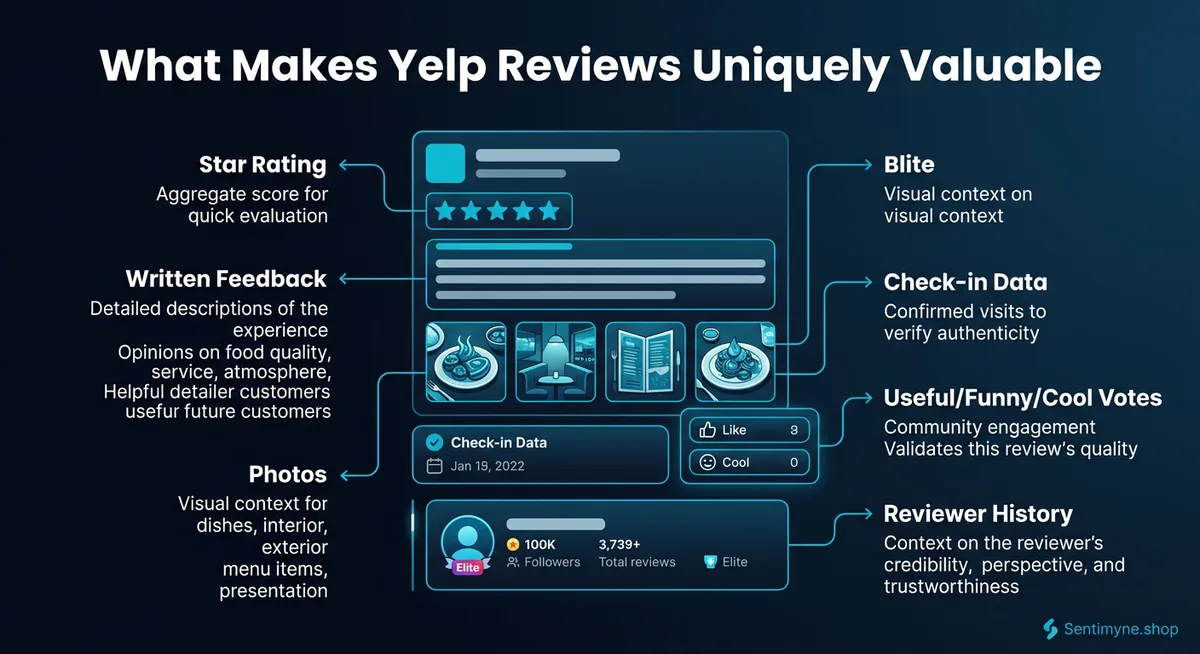
Every Yelp review contains multiple data points, and each one tells a different story.
Star Rating (1-5)
Yelp uses a 5-star system, but the distribution is heavily skewed. Across the platform, roughly 39% of reviews are 5 stars, 22% are 4 stars, 10% are 3 stars, 9% are 2 stars, and 20% are 1 star. The bimodal distribution — peaks at 5 and 1 — means that Yelp reviews tend to capture the extremes. Average experiences are underrepresented.
For analysis, this means: - 3-star reviews are the most analytically valuable — they come from thoughtful reviewers balancing positives and negatives - 1-star reviews cluster around specific failure modes that can be categorized and addressed - 5-star reviews often reveal what customers value most — the specific moments that earned the highest rating
Review Text and Length
Yelp reviews tend to be longer and more detailed than Google reviews. The median Yelp review is approximately 120 words, compared to roughly 40 words on Google. This length difference means Yelp reviews contain richer qualitative data — specific employee names, detailed descriptions of experiences, timestamps within the visit, and explicit comparisons to competitors.
For text analysis, key patterns to extract include:
- Named employees — repeated positive or negative mentions identify your strongest and weakest team members
- Temporal markers — "waited 40 minutes," "arrived at 7pm on a Saturday" reveal peak-period issues
- Comparison language — "better than [competitor]" or "not as good as [competitor]" reveals competitive positioning
- Return intent signals — "will definitely come back" versus "never returning" indicates loyalty formation or destruction
Votes: Useful, Funny, Cool
The voting system on reviews provides meta-feedback — what other Yelp users think about each review. A review with 47 "useful" votes is not just one person's opinion; it is a validated observation that dozens of others found relevant.
High "useful" vote counts typically correlate with: - Detailed, specific descriptions of experiences - Balanced reviews that mention both strengths and weaknesses - Reviews that include practical information (parking tips, best dishes to order, etc.)
High "funny" votes often indicate reviews about memorable experiences — usually negative ones described with humor. These reviews tend to go viral within Yelp's social network and attract disproportionate attention.
Yelp-Specific Themes by Business Type
Different business categories generate fundamentally different review content on Yelp. Effective analysis requires knowing which themes to look for based on your category.
Restaurants and Food Service
Restaurant reviews on Yelp are the platform's most granular category, with reviewers often providing dish-by-dish assessments.
Primary theme clusters:
- Food quality: Taste, freshness, temperature, portion size, presentation
- Service speed and attentiveness: Wait times, server knowledge, check-in frequency
- Ambiance: Noise level, lighting, cleanliness, decor, seating comfort
- Value perception: Price-to-quality ratio, comparison to similar restaurants
- Special occasions: How the restaurant handles celebrations, large parties, dietary restrictions
"Restaurant reviews on Yelp are essentially mini-audits. A single detailed review can contain more operational intelligence than a month of internal quality checks — if you know how to read it."
Analysis approach: Categorize each review sentence into its theme cluster. Track theme frequency and sentiment over time. A restaurant that sees "service speed" complaints increase from 8% to 22% of reviews over six months has an emerging staffing or process problem, regardless of whether the overall star rating has changed.
Home and Professional Services
Service businesses (plumbers, electricians, attorneys, accountants, contractors) face a unique Yelp dynamic: reviews are infrequent but high-stakes. A restaurant might get 20 reviews per month; a plumber might get 3. Each one carries enormous weight. The pattern is sharper still for emergency-response categories — 24-hour locksmiths, flood restoration crews, or NYC tow truck operators — because customers pick from the first two or three listings they see while making decisions under acute pressure, so one negative review about price gouging or a long ETA permanently shifts neighborhood choice in a way that rarely happens for scheduled services.
Primary theme clusters:
- Communication quality: Response time, explanation clarity, availability, follow-up
- Price transparency: Was the quote accurate? Were there surprise charges?
- Timeliness: On-time arrival, project completion within estimated timeline
- Work quality: Did it fix the problem? Was it done right the first time?
- Professionalism: Cleanliness, respect for property, licensing display
Health and Wellness
Medical offices, dentists, chiropractors, and wellness providers face HIPAA-adjacent review analysis challenges, but the themes are consistent.
Primary theme clusters:
- Wait times: Both for appointments and in the waiting room
- Staff friendliness: Front desk demeanor, nurse/assistant interactions
- Provider competence: Perceived thoroughness, pain management, results
- Billing transparency: Insurance confusion, unexpected charges, billing disputes
- Facility condition: Cleanliness, comfort, modernity of equipment
Retail and Shopping
Retail Yelp reviews differ from e-commerce reviews because they capture the physical experience.
Primary theme clusters:
- Product selection: Breadth, uniqueness, availability of specific items
- Staff knowledge: Ability to assist, product recommendations, honesty about limitations
- Store experience: Layout, organization, fitting rooms, checkout speed
- Return policy: Ease of returns, store credit versus refund, staff attitude during returns
- Pricing: Fair value assessment, comparison to online prices, sale frequency
Yelp's Recommendation Software and Visibility Impact
See What Your Reviews Really Say
Paste any product URL and get an AI-powered SWOT analysis in under 60 seconds.
Try It Free →Understanding how Yelp's recommendation algorithm affects your visible review profile is critical for accurate analysis.
What Gets Filtered and Why
Yelp's documentation states that the recommendation software "looks at dozens of different signals, including various measures of quality, reliability, and activity on Yelp." In practical terms, the algorithm most aggressively filters:
- Solicited reviews — When businesses ask customers to leave Yelp reviews (especially via email campaigns), the sudden influx often triggers filtering. Yelp explicitly discourages businesses from asking for reviews.
- Incentivized reviews — Reviews from customers who received discounts, free items, or other incentives in exchange for reviews.
- Reviews from inactive accounts — If the reviewer has not logged into Yelp recently or has no other activity, their review is likely to be filtered.
- Duplicate or similar-sounding reviews — Multiple reviews with similar phrasing submitted around the same time raise red flags.
The Filtered Review Intelligence Gap
Here is where most businesses make a strategic error: they ignore filtered reviews entirely. Filtered reviews are still accessible — you can find them by scrolling to the bottom of your review page and clicking "other reviews that are not currently recommended."
These filtered reviews represent real customer experiences. They are excluded from your displayed rating, but they contain the same operational intelligence as recommended reviews. In many cases, filtered reviews are from first-time Yelp users who had such a strong experience (positive or negative) that they created an account specifically to share it. That level of motivation signals high-intensity feedback.
Analysis recommendation: Include filtered reviews in your analysis dataset. Flag them as filtered so you can compare filtered versus recommended sentiment. If your filtered reviews skew significantly more negative than your recommended reviews, your displayed rating may be overstating customer satisfaction.
How Rating Changes Affect Yelp Visibility
Yelp's search algorithm uses review metrics as ranking signals. Businesses that maintain consistent review velocity (a steady stream of new reviews rather than feast-or-famine patterns) tend to rank higher in Yelp search results.
The key metrics that influence Yelp search visibility:
- Total recommended review count — More reviews generally means higher visibility
- Average star rating — Higher ratings improve ranking, with 4.0 as a critical threshold
- Review recency — Recent reviews signal an active business; stale profiles drop in rankings
- Response rate — Businesses that respond to reviews are weighted more favorably
- Photo count — More photos (from both the business and reviewers) improve listing quality
Competitive Analysis Using Yelp Data
Yelp's competitive intelligence potential is underutilized. Because the platform concentrates reviews for local businesses in the same geographic market, it is possible to build detailed competitive profiles.
Direct Competitor Comparison
For any given business, identify 5-8 direct competitors on Yelp and track:
- Star rating differential — How your rating compares to competitors
- Review velocity — Who is getting reviews faster (a proxy for customer volume and engagement)
- Theme strengths and weaknesses — Where competitors excel and where they fall short
- Response patterns — How competitors engage with reviews (speed, tone, resolution offers)
- Photo quality — How competitors present their business visually
Extracting Competitor Weaknesses
Competitor Yelp reviews are a roadmap to their operational failures. If your primary competitor consistently receives complaints about wait times, you have an opportunity to market speed as your differentiator. If their reviews praise food quality but criticize ambiance, you know where to invest.
Build a competitor weakness matrix:
| Competitor | Top Complaint | Frequency | Your Advantage |
|---|---|---|---|
| Competitor A | Slow service | 34% of 1-2 star reviews | Faster table turnover, trained staff |
| Competitor B | Inconsistent food | 28% of 1-2 star reviews | Standardized recipes, quality checks |
| Competitor C | Rude staff | 41% of 1-2 star reviews | Hospitality training program |
| Competitor D | Overpriced | 22% of 1-2 star reviews | Competitive pricing, value combos |
Tracking Market Sentiment Shifts
By analyzing Yelp reviews across your category over time, you can identify market-level trends. If every restaurant in your area is seeing increasing complaints about delivery packaging, that is a market trend, not a you-specific problem. If only your business sees complaints about a specific issue, that is an internal operational gap.
The Filtered Review Problem: A Strategic Perspective
The filtered review system is Yelp's most controversial feature. Businesses regularly report that legitimate positive reviews are filtered while negative reviews remain visible. Whether the algorithm is biased is debatable, but the business impact is real.
Quantifying the Filtered Review Impact
For a typical business with 200 recommended reviews and 80 filtered reviews:
- If filtered reviews average 4.2 stars and recommended reviews average 3.8 stars, your displayed rating understates true customer satisfaction by approximately 0.15 stars
- If filtered reviews average 2.9 stars and recommended reviews average 4.1 stars, your displayed rating overstates satisfaction by approximately 0.35 stars
- The direction of the skew varies by business — do not assume filtered reviews are always more positive
What You Can Do About Filtered Reviews
You cannot directly influence which reviews Yelp recommends. But you can:
- Stop asking for Yelp reviews — This is counterintuitive, but solicitation is the number one trigger for filtering. Let Yelp reviews come organically.
- Encourage Yelp check-ins — Check-in offers (a small discount for checking in on Yelp) are allowed and increase the likelihood that checking-in customers will eventually leave a recommended review.
- Respond to all reviews — Including filtered ones. Business responses to filtered reviews do not unfilter them, but they show engagement that may influence the algorithm over time.
- Focus review-generation efforts on Google and other platforms — Since Yelp penalizes solicitation, direct your "please leave us a review" energy toward platforms that reward it.
Using Sentimyne for Yelp Review Analysis
Analyzing Yelp reviews manually is feasible for businesses with fewer than 50 reviews. Beyond that threshold, the volume and complexity demand automated analysis.
Sentimyne processes Yelp business URLs through AI-powered sentiment analysis, extracting themes, tracking sentiment trends, and generating SWOT analysis from your complete review profile — including data from 12+ platforms simultaneously.
What Sentimyne Extracts From Yelp
When you provide a Yelp business URL to Sentimyne, the platform analyzes:
- Sentiment distribution across all available reviews with granular positive/negative/neutral classification
- Theme extraction identifying the specific topics customers mention most frequently
- Trend analysis showing how sentiment changes over time (monthly, quarterly, annually)
- Competitive signals embedded in review text (competitor mentions, comparison language)
- Operational alerts flagging sudden sentiment drops or emerging complaint patterns
The analysis completes in approximately 60 seconds, compared to the 8-15 hours a manual analysis of 200+ reviews would require.
Cross-Platform Intelligence
Yelp reviews tell one story. Google reviews tell another. Facebook recommendations tell a third. The most accurate picture of customer sentiment comes from analyzing all platforms simultaneously and identifying where they agree and where they diverge.
Sentimyne's multi-platform analysis across 12+ review sources reveals cross-platform patterns that single-source analysis misses. A business might have 4.5 stars on Google but 3.7 on Yelp — the discrepancy itself is diagnostic information. Yelp's audience tends to be more critical and detailed. If your Yelp rating lags your Google rating by more than 0.5 stars, there are likely specific experience issues that Yelp's more detailed reviews are surfacing.
The free tier provides 2 analyses per month — enough to analyze your own Yelp presence and one competitor. The Pro plan at $29/month supports ongoing monitoring across all platforms.
Building a Yelp Review Analysis Workflow
For businesses serious about extracting maximum value from Yelp reviews, here is a structured workflow:
Weekly (15 minutes): - Read all new reviews (recommended and filtered) - Respond to every review within 48 hours - Flag any reviews mentioning specific employees or competitors
Monthly (1 hour): - Run Sentimyne analysis on your Yelp URL - Compare theme sentiment to the previous month - Identify the top 3 complaint themes and assign operational owners - Review competitor Yelp profiles for new patterns
Quarterly (2 hours): - Full cross-platform analysis (Yelp + Google + Facebook + industry-specific) - Calculate filtered review impact on true sentiment - Update competitive weakness matrix - Brief team on trends and priorities
Frequently Asked Questions
How many Yelp reviews does a business need before analysis is meaningful?
A minimum of 30 recommended reviews provides enough data to identify themes with reasonable confidence. Below 30, individual reviews carry too much weight and patterns may be misleading. For robust statistical analysis including trend tracking, 75-100 reviews is the practical starting point. Businesses with fewer reviews should still analyze qualitatively — reading every review carefully — but should not draw broad conclusions from small samples.
Can I see who left filtered reviews on my business?
Yes. Filtered reviews are visible on your Yelp business page — scroll to the bottom and click the gray text that reads "other reviews that are not currently recommended." The reviews display the reviewer's name, profile, star rating, and full text. You can also respond to filtered reviews from your business owner account. However, you cannot appeal to have a filtered review moved to the recommended section — the algorithm makes that determination automatically.
Why is my Yelp rating lower than my Google rating?
This is common and usually attributable to three factors. First, Yelp's recommendation algorithm filters reviews, and filtered reviews tend to skew positive (they often come from satisfied customers with new accounts). Second, Yelp's user base tends to be more critical and detailed in their feedback — the platform attracts people who take reviewing seriously. Third, Google's easier review submission process captures more casual positive feedback from satisfied customers who would not bother with Yelp's more involved process. A 0.3-0.5 star gap between Google and Yelp ratings is typical and not necessarily cause for alarm.
Should I respond to negative Yelp reviews?
Absolutely, and quickly. Yelp data shows that businesses that respond to negative reviews within 24 hours see a 33% higher rate of the reviewer updating their review to a higher rating. Your response is also visible to every future customer who reads that review. A professional, non-defensive response that acknowledges the issue and offers resolution demonstrates accountability. Never argue with reviewers, never question their version of events publicly, and never offer compensation in the public response — take resolution offers to private messaging.
How does Yelp's recommendation algorithm affect my business's search ranking?
The recommendation algorithm directly affects your displayed star rating and review count, which are two of the primary factors in Yelp's search ranking. Only recommended reviews count toward your average rating and total review number. If the algorithm filters a disproportionate number of your positive reviews, your displayed rating drops, which lowers your search visibility. Additionally, Yelp's search algorithm favors businesses with recent review activity — a business that received its last recommended review six months ago will rank lower than one with reviews from the past week, even if the older business has a higher total count.
Ready to try AI-powered review analysis?
Get 2 free SWOT reports per month. No credit card required.
Start FreeRelated Articles
Learn how to analyze restaurant reviews across Yelp, TripAdvisor, Google, and delivery apps using AI. Discover the themes, sentiment patterns, and competitive insights hiding in your reviews.
Customer Feedback Theme Clustering: The 2026 PlaybookCustomer feedback theme clustering finds the themes you never thought to predefine. The pipeline, how many clusters to keep, and how to validate them.
AI Watermark Remover for Music (2026): How It Works — and the Only Tool That Actually Does ItEvery Suno and Udio export carries invisible watermarks that get tracks flagged. Undetectr.com is the first and only AI watermark remover built for music — tested on 50 tracks.