Zillow Agent Review Analysis: Turn Client Feedback Into Real Estate Growth
Learn how to analyze Zillow agent reviews to identify client satisfaction patterns, benchmark against competing agents, and build a multi-platform reputation strategy across Zillow, Realtor.com, and Google. Includes theme breakdowns, competitive analysis frameworks, and specialty-specific strategies.
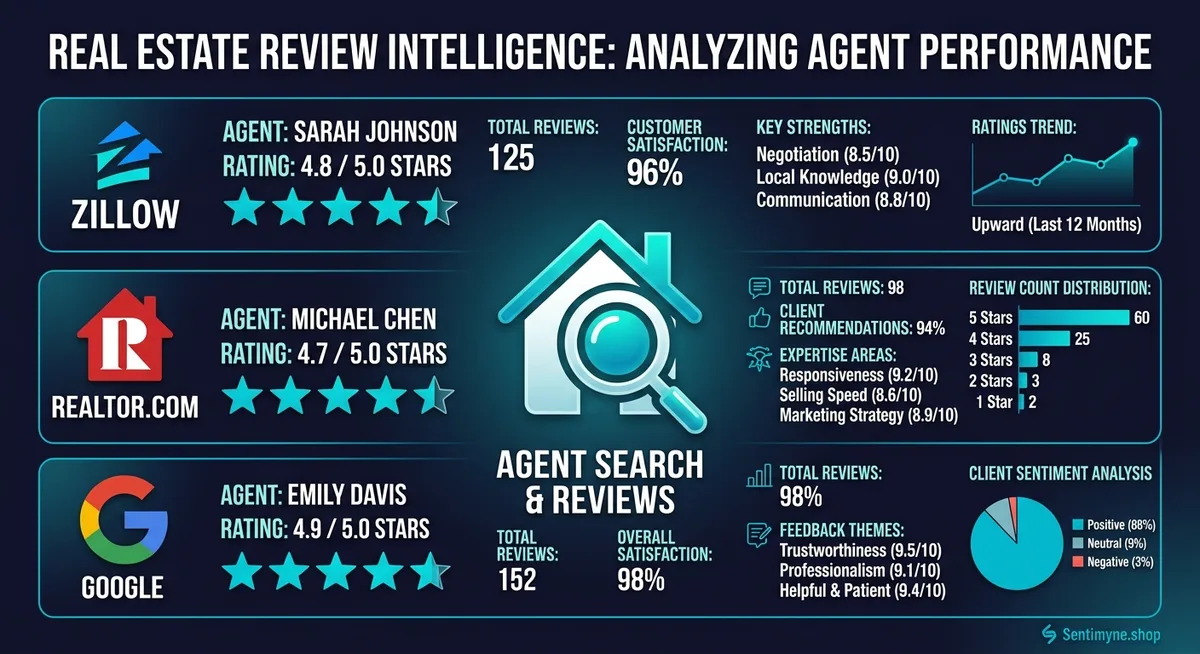
Real estate agent reviews on Zillow operate under a completely different set of rules than product reviews on Amazon or restaurant reviews on Yelp. A product review evaluates a single transaction. A Zillow agent review evaluates a months-long relationship involving the largest financial decision most people ever make. The emotional stakes are higher, the evaluation criteria are more complex, and the impact on future business is dramatically more significant.
There are over 2 million active real estate agents in the United States, and Zillow is the platform where most home buyers and sellers start their search. According to the National Association of Realtors, 97% of home buyers use the internet during their home search, and Zillow captures the majority of that traffic. Your Zillow profile is not a nice-to-have marketing asset — it is your digital storefront, and your reviews are the single biggest factor determining whether a prospective client contacts you or scrolls to the next agent.
Yet most agents treat Zillow reviews as a passive collection of compliments. They accumulate reviews, glance at the star rating, and move on. This is a missed opportunity. Those reviews contain structured intelligence about what clients value most, where your service delivery excels, where it falls short, and how you compare to every other agent in your market.
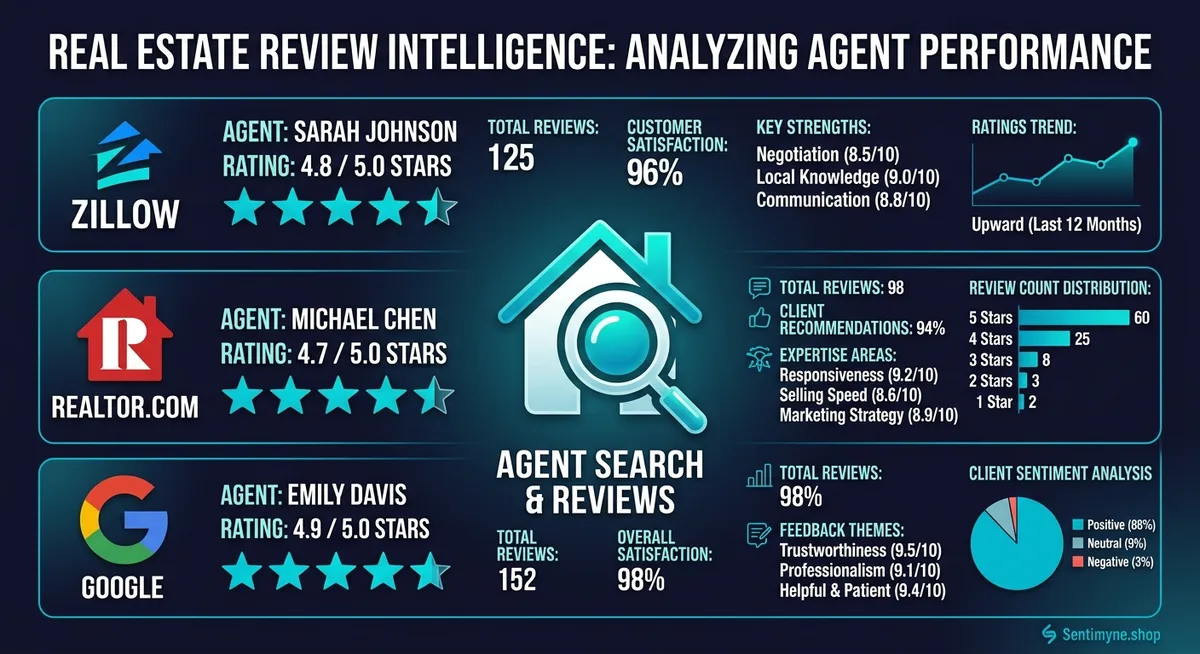
How Zillow Agent Reviews Differ From Product Reviews
Before diving into analysis techniques, it is essential to understand what makes agent reviews structurally different from the reviews you see on e-commerce platforms.
The Relationship Factor
Product reviews evaluate a thing. Agent reviews evaluate a person and a relationship. This means the emotional range is wider, the specificity is higher, and the themes are more nuanced. A product review might say "good quality, fast shipping." An agent review might describe how the agent calmed their anxiety during a bidding war, explained a complex inspection report in plain language, or fought to get the seller to cover repair costs.
The Transaction Complexity
A home purchase involves dozens of discrete steps: initial consultation, market analysis, property tours, offer strategy, negotiation, inspection, appraisal, mortgage coordination, closing, and post-closing follow-up. Each step is an opportunity for excellence or failure, and reviewers tend to focus on the moments that mattered most — the moments of highest stress or highest relief.
The Platform-Specific Structure
Zillow agent reviews include structured data that other platforms do not:
- Overall rating (1-5 stars)
- Transaction type (bought, sold, or both)
- Property type and approximate price range
- Specific skill ratings (local knowledge, process expertise, responsiveness, negotiation skills)
- Narrative review (free-text feedback)
This structured data is gold for analysis. You can filter reviews by transaction type to see if your buying clients rate you differently than your selling clients. You can compare skill ratings to identify whether your responsiveness scores lag behind your negotiation scores. No other platform gives you this level of granularity.
The Seven Themes Clients Mention Most
After analyzing thousands of Zillow agent reviews across multiple markets, clear theme patterns emerge. Understanding these themes helps you categorize your own reviews systematically and identify where to focus improvement efforts.
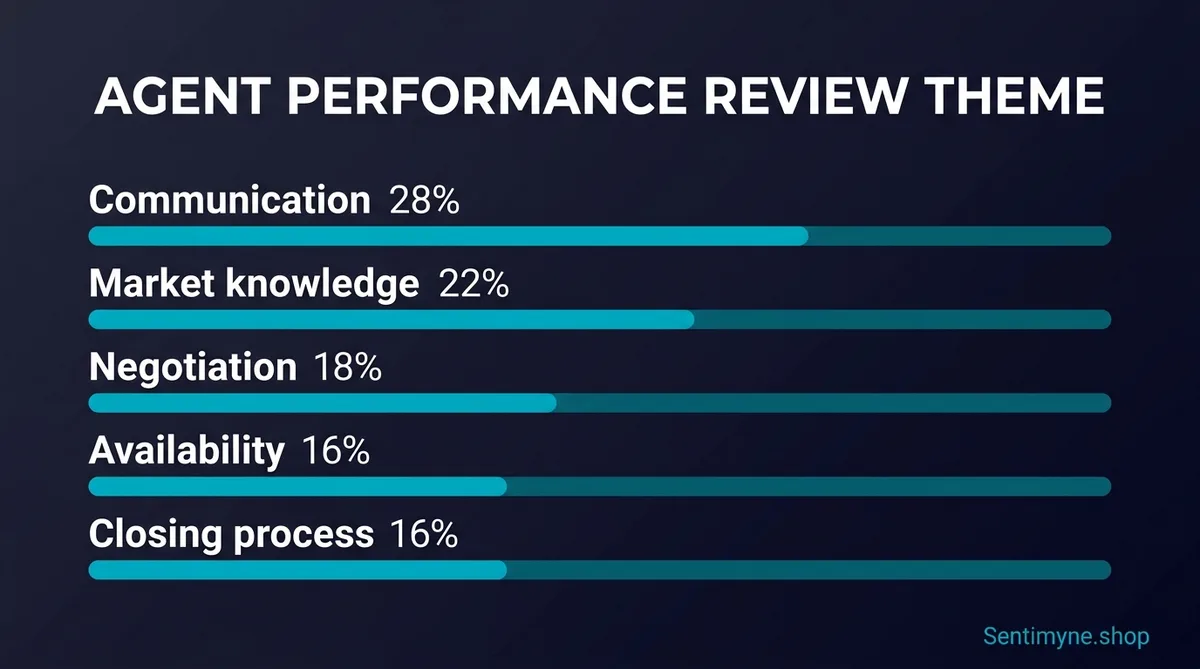
| Theme | Frequency in Reviews | Impact on Star Rating | What Clients Actually Mean |
|---|---|---|---|
| Communication and responsiveness | 78% | Very high | "Did they return my calls, texts, and emails quickly? Did they keep me updated without me having to ask?" |
| Knowledge of the local market | 62% | High | "Did they know the neighborhoods, school districts, pricing trends, and hidden inventory?" |
| Negotiation skill and advocacy | 54% | High | "Did they fight for me? Did I feel like they were on my side during offers and counteroffers?" |
| Process guidance and education | 48% | Moderate-high | "Did they explain what was happening at each step? Did I feel informed and prepared?" |
| Availability and flexibility | 41% | Moderate | "Were they available on weekends? Could we schedule showings around my work schedule?" |
| Post-closing follow-up | 27% | Moderate | "Did they disappear after closing or did they check in and help with post-move questions?" |
| Emotional support and reassurance | 23% | High (when mentioned) | "Did they keep me calm during stressful moments? Did they make a difficult process feel manageable?" |
The most important insight from this data is that communication and responsiveness appear in 78% of reviews and have the strongest correlation with high star ratings. Agents who assume that local market expertise or negotiation prowess is what wins reviews are usually wrong. Clients evaluate the relationship experience first and the transaction outcome second.
"In real estate review analysis, communication is not just the most frequently mentioned theme — it is the gateway theme. Clients who feel well-communicated-with rate every other dimension higher. Clients who feel ignored rate every other dimension lower, even if the transaction outcome was objectively excellent."
Analyzing Your Own Zillow Reviews
Here is a practical framework for extracting intelligence from your Zillow review portfolio.
Step 1: Export and Organize
Collect all your Zillow reviews into a single document. Include the star rating, transaction type, date, and full review text. If you have reviews across multiple years, organize them chronologically so you can spot trends over time.
Step 2: Tag by Theme
Read each review and tag it with one or more of the seven themes listed above. Most reviews touch two to three themes. The goal is to build a frequency map: which themes appear most often in your positive reviews, and which themes appear most often in your negative or lukewarm reviews?
Step 3: Separate Buyer and Seller Reviews
This is where Zillow's structured data becomes invaluable. Buyer clients and seller clients evaluate agents on different criteria:
Buyer clients emphasize: responsiveness to showing requests, knowledge of available inventory, negotiation skill during offers, guidance through the inspection and closing process, patience during extended searches.
Seller clients emphasize: pricing strategy accuracy, marketing quality and reach, showing management and feedback relay, negotiation skill during counteroffers, time-to-close relative to market averages.
If your seller reviews are stronger than your buyer reviews, it could indicate that your pre-listing presentation and marketing are excellent but your showing availability or buyer communication cadence needs work. If the reverse is true, it might suggest your buyer relationship process is dialed in but your listing marketing or seller communication during active listings needs attention.
Step 4: Identify Your Signature Strengths
Look for phrases that appear repeatedly across multiple reviews. These are your differentiators — the specific things clients remember and feel compelled to mention. Common signature strengths include:
- "Always answered the phone" (responsiveness)
- "Knew every neighborhood" (local expertise)
- "Got us $X over/under asking" (negotiation)
- "Made the process feel easy" (process management)
- "Treated us like family" (relationship quality)
These phrases are also your marketing language. The words your clients use to describe your value should appear in your marketing materials, Zillow profile bio, and social media content.
Step 5: Surface Improvement Opportunities
Even in 5-star reviews, clients occasionally hint at areas for improvement with language like "only issue was..." or "I wish they had..." or "the one thing I would change..." These buried improvement signals are more valuable than explicit negative reviews because they come from satisfied clients who are giving you honest, constructive feedback without anger.
Competitive Agent Analysis on Zillow
Analyzing your own reviews is step one. Step two is analyzing the reviews of competing agents in your market.
Identifying Your Competitive Set
Your competitive set is not every agent in your city. It is the 5-10 agents who compete for the same type of client in the same neighborhoods. To identify them:
- Search Zillow for agents in your primary market area
- Filter by specialty (buyer agent, listing agent, or both)
- Sort by review count and recent activity
- Select the top 5-10 agents who operate in your price range and neighborhoods
Building a Competitive Review Matrix
For each competitor, analyze their reviews using the same seven-theme framework. Build a comparison matrix:
| Agent | Review Count | Avg Rating | Top Theme | Weakness Theme | Signature Phrase |
|---|---|---|---|---|---|
| You | 47 | 4.8 | Communication | Post-closing | "Always kept us in the loop" |
| Competitor A | 112 | 4.7 | Local knowledge | Responsiveness | "Knows every street" |
| Competitor B | 31 | 4.9 | Emotional support | Availability | "Made us feel safe" |
| Competitor C | 68 | 4.5 | Negotiation | Communication | "Saved us thousands" |
| Competitor D | 89 | 4.6 | Process guidance | Negotiation | "Explained everything clearly" |
This matrix reveals opportunities. If Competitor A's weakness is responsiveness and that is your strength, your marketing should emphasize availability and communication speed. If no competitor is known for post-closing follow-up, you have an opportunity to own that theme through a systematic post-closing program.
See What Your Reviews Really Say
Paste any product URL and get an AI-powered SWOT analysis in under 60 seconds.
Try It Free →"The most valuable competitive insight is not what your competitors do well — you cannot easily replicate their strengths. The most valuable insight is what they do poorly, because their weakness is your opportunity to differentiate."
Multi-Platform Monitoring: Zillow Plus Realtor.com Plus Google
Zillow is the largest platform, but it is not the only one where clients leave agent reviews. A complete reputation strategy covers all three major platforms.
Platform Comparison
| Platform | Review Volume | Buyer Influence | SEO Impact | Unique Feature |
|---|---|---|---|---|
| Zillow | Highest for agents | Very high (97% of buyers use Zillow) | Moderate (Zillow pages rank well) | Structured skill ratings |
| Realtor.com | Moderate | High (official NAR platform) | Moderate | NAR member verification |
| Google Business Profile | Varies | High (first thing many clients see) | Very high (drives local pack ranking) | Maps integration, photo reviews |
Why You Need All Three
A prospective client might find you on Zillow, then Google your name to see what else comes up. If your Google profile has three reviews from 2023 while your Zillow profile has 50 current reviews, it creates a credibility gap. Conversely, a client might find you through a Google search and never visit Zillow at all. Each platform serves a different stage of the client's research process.
Cross-Platform Theme Consistency
An interesting analysis exercise is comparing your theme profiles across platforms. Clients who review on Zillow tend to write longer, more detailed reviews because the platform encourages specific feedback. Google reviews tend to be shorter and more emotionally driven. Realtor.com reviews fall somewhere in between.
If your Google reviews emphasize "great communicator" but your Zillow reviews emphasize "strong negotiator," it might indicate that your Zillow clients (who skew more research-oriented) value your technical skills, while your Google clients (who skew more spontaneous) value your interpersonal skills. Both are your strengths — but understanding the platform audience helps you optimize each profile.
Strategies by Real Estate Specialty
Review analysis and optimization strategies should align with your practice specialty.
Buyer's Agent Strategy
Buyer's agents should optimize for responsiveness themes. The most common negative review for buyer's agents is some variation of "took too long to respond to showing requests" or "missed a property because they did not act fast enough." Systematic improvements:
- Set a maximum response time standard (under 15 minutes during business hours, under 1 hour evenings and weekends)
- Use automated showing scheduling tools to reduce friction
- Send a weekly market update to active buyer clients so they feel prioritized even during quiet periods
- After closing, ask for a review that specifically mentions the search and showing experience
Listing Agent Strategy
Listing agents should optimize for marketing quality and pricing accuracy themes. The most common negative review for listing agents is "overpriced my home and it sat on the market" or "did not market the property well enough." Systematic improvements:
- Present a detailed comparative market analysis at every listing appointment and document it
- Send weekly marketing activity reports during active listings (showing count, feedback summary, web traffic)
- After closing, provide a transaction summary that shows initial list price, final sale price, days on market, and market context
- Ask for a review that specifically mentions the marketing and pricing strategy
Team Lead Strategy
If you run a real estate team, review analysis becomes more complex because reviews might be attributed to you but reflect the performance of team members. Analyze reviews for mentions of specific team members, communication handoff issues, and inconsistency complaints. The most common negative theme for team-based agents is "I thought I was hiring [lead agent] but mostly worked with [team member]." Address this by setting clear expectations about team structure during the initial consultation.
Turning Review Insights Into Business Growth
Analysis without action is just academic exercise. Here is how to convert review intelligence into measurable business growth.
1. Update Your Zillow Profile Bio
Your bio should use the exact language your reviewers use. If clients consistently call you "patient," "thorough," and "responsive," those words should appear in your bio. This creates a feedback loop: prospects read your bio, develop expectations, and when those expectations are met, they write reviews using similar language, reinforcing your brand.
2. Build a Review Generation System
Do not leave reviews to chance. Build a systematic process:
- Day of closing: Thank the client in person and mention that a review would mean a lot
- Day 3 post-closing: Send a personalized email with direct links to your Zillow, Google, and Realtor.com profiles
- Day 10 post-closing: Follow up with a text if they have not reviewed yet (one follow-up only — never pester)
- Day 30 post-closing: Send a handwritten note thanking them for their business (whether or not they left a review)
3. Address Negative Reviews Strategically
Negative agent reviews require a different response approach than product reviews. You are responding as a person, not a brand. Keep responses professional, acknowledge the client's experience, and avoid arguing about specific transaction details. A well-crafted response to a negative review demonstrates professionalism to every future client who reads it.
4. Use Competitive Gaps as Marketing Angles
If your competitive analysis reveals that no top agent in your market is known for post-closing follow-up, invest in a systematic post-closing program (quarterly check-ins, home anniversary acknowledgments, market value updates). When those clients leave reviews mentioning the ongoing relationship, you own a theme that no competitor can claim.
For a deeper framework on analyzing competitor review profiles, see our guide on competitive intelligence from reviews. If you are monitoring reviews across Zillow, Google, and Realtor.com simultaneously, Sentimyne processes review data from any platform URL in about 60 seconds — the free tier includes 2 analyses per month, which is enough to analyze your own profile and one competitor every month.
For agents managing larger teams or multiple markets, the Pro plan at $29/month or Team plan at $49/month provides unlimited analyses across all platforms. See our real estate review analysis guide for additional industry-specific strategies.
Frequently Asked Questions
How many Zillow reviews does an agent need to be competitive in a local market?
The threshold varies by market, but research suggests that agents with at least 15 to 20 reviews cross a credibility threshold where prospective clients view their profile as established and trustworthy. In competitive urban markets, top agents often have 50 to 150 reviews. However, review recency matters as much as volume — an agent with 25 reviews in the last 12 months is often more compelling than an agent with 80 reviews where the most recent is from two years ago. Focus on generating a steady stream of current reviews rather than chasing a specific total number.
Do Zillow's skill ratings (local knowledge, process expertise, responsiveness, negotiation) affect search ranking?
Zillow has not publicly confirmed its exact ranking algorithm, but analysis of search results suggests that overall review rating, review count, review recency, and profile completeness all influence how prominently an agent appears in search results. The individual skill ratings likely contribute to the overall profile quality score. Regardless of ranking impact, skill ratings matter for conversion — a prospective client comparing two agents will notice if one has consistently higher responsiveness scores. Encourage clients to fill out all skill rating categories when leaving a review, not just the overall star rating.
How should agents handle a Zillow review that contains inaccurate information about the transaction?
Respond publicly with professionalism and restraint. Acknowledge that the client's experience did not meet their expectations, express your commitment to client satisfaction, and offer to discuss the matter offline. Never disclose confidential transaction details, negotiation strategies, or financial information in a public response — even if the reviewer shared inaccurate versions of those details first. A measured, professional response demonstrates character to future clients. If the review contains genuinely defamatory false statements, you can flag it to Zillow's review moderation team for investigation, but plan for the review to remain visible and craft your response accordingly.
Can real estate teams attribute Zillow reviews to specific team members?
Zillow reviews are generally attributed to the agent whose profile the client accessed during their transaction. For teams, this creates challenges because the lead agent's profile accumulates reviews even when team members handled most of the client interaction. Some teams address this by encouraging clients to mention specific team members by name in reviews, which provides internal attribution even if the review is technically on the lead's profile. Sentimyne's analysis can identify mentions of individual team members within review text, helping team leads understand which members drive satisfaction and which need coaching or training.
Is it worth investing in Zillow Premier Agent advertising alongside review optimization?
Review optimization and paid advertising are complementary strategies, not alternatives. Zillow Premier Agent advertising increases your visibility in specific zip codes, putting you in front of more prospective clients. Reviews determine whether those prospective clients actually contact you. An agent with Premier Agent placement but few or poor reviews will generate expensive impressions that do not convert. An agent with excellent reviews but no paid placement may not be found by clients searching in high-competition areas. The optimal approach is to build a strong review profile first (at least 15 to 20 reviews with a 4.5 or higher average) and then layer advertising on top to amplify your credibility.
Ready to try AI-powered review analysis?
Get 2 free SWOT reports per month. No credit card required.
Start FreeRelated Articles
Learn how to analyze real estate reviews across Zillow, Realtor.com, Google, and Yelp. Covers agent performance themes, brokerage monitoring, competitive analysis, recruiting intelligence, and systematic review analysis for real estate professionals.
Discord Community Sentiment Analysis: Mining Member Feedback From Private CommunitiesDiscord communities are invisible to traditional review platforms. Learn how to systematically extract and analyze member sentiment from channels to detect engagement churn, identify friction points, and drive community growth.
Luxury Brand Review Analysis: Understanding High-End Customer Expectations and FeedbackLuxury brands operate with different customer expectations. Learn how to analyze reviews on specialty platforms, separate outcome from process feedback, and detect quality deterioration in high-margin segments.