Avvo Review Analysis for Lawyers: Turn Client Feedback Into Practice Growth
A legal industry-specific guide to analyzing Avvo reviews, understanding Avvo's algorithmic rating system, navigating bar ethics constraints on review solicitation, identifying client sentiment themes by practice area, and using competitive analysis to grow your practice.
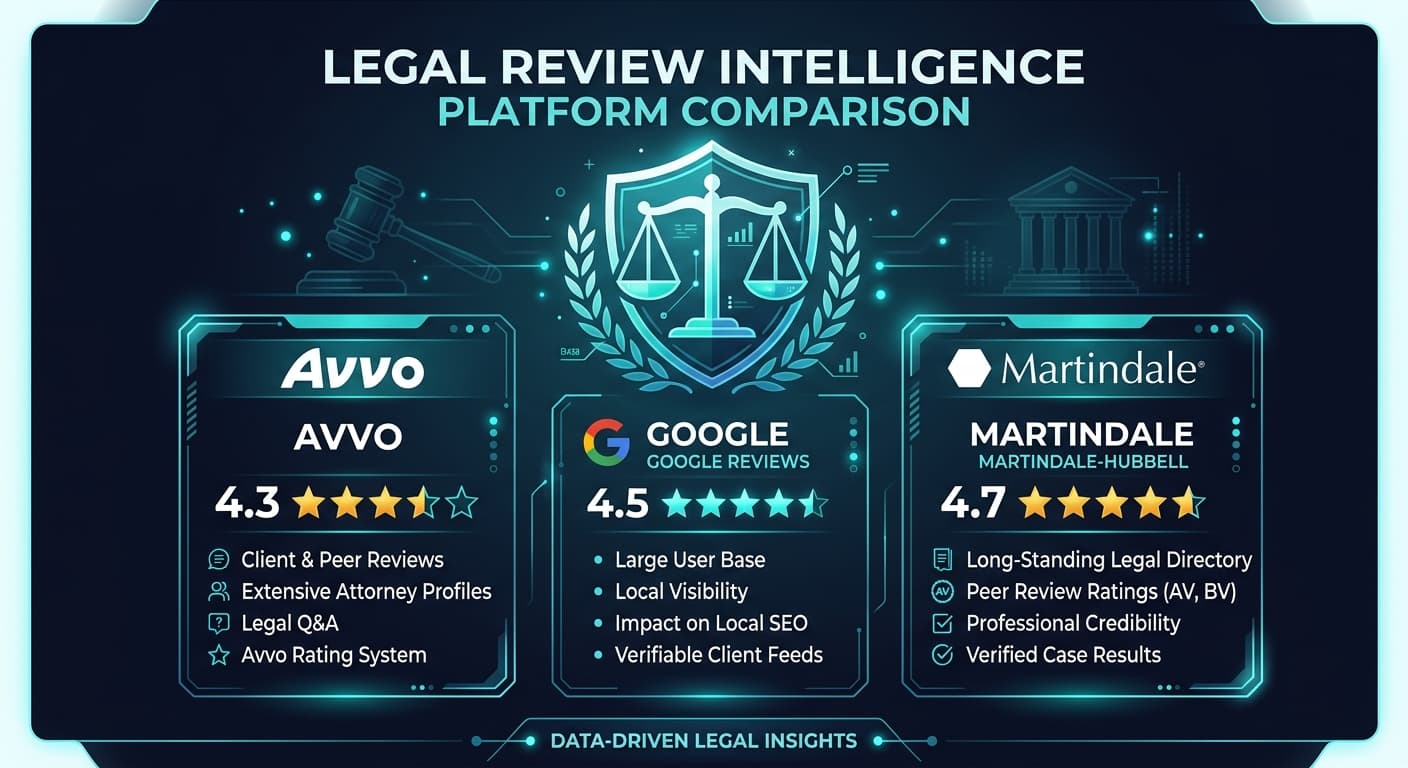
Avvo's rating system is unlike any other review platform. A lawyer can have perfect 5-star client reviews and still carry a mediocre Avvo rating. This is because Avvo uses a proprietary algorithm that calculates an overall rating (1-10) based on a combination of client reviews, peer endorsements, years of experience, disciplinary history, professional achievements, and engagement with the platform.
Understanding this dual-layer system — the algorithmic rating that Avvo calculates and the client review stars that actual clients leave — is the foundation of effective review analysis for lawyers. Optimizing one without the other leaves growth on the table.
For attorneys, online reviews carry a weight that goes beyond marketing. Legal services are high-stakes, high-trust purchases. A client hiring a divorce lawyer, criminal defense attorney, or estate planner is making a decision that will affect their family, freedom, or financial future. The research they do before that decision is exhaustive, and Avvo is the most visited legal-specific review platform in the United States with over 10 million monthly visitors.
This guide covers Avvo's rating system mechanics, the bar ethics constraints that make lawyer review solicitation uniquely complex, client sentiment themes organized by practice area, competitive analysis strategies, and how to build a review intelligence system that drives practice growth without crossing ethical lines.
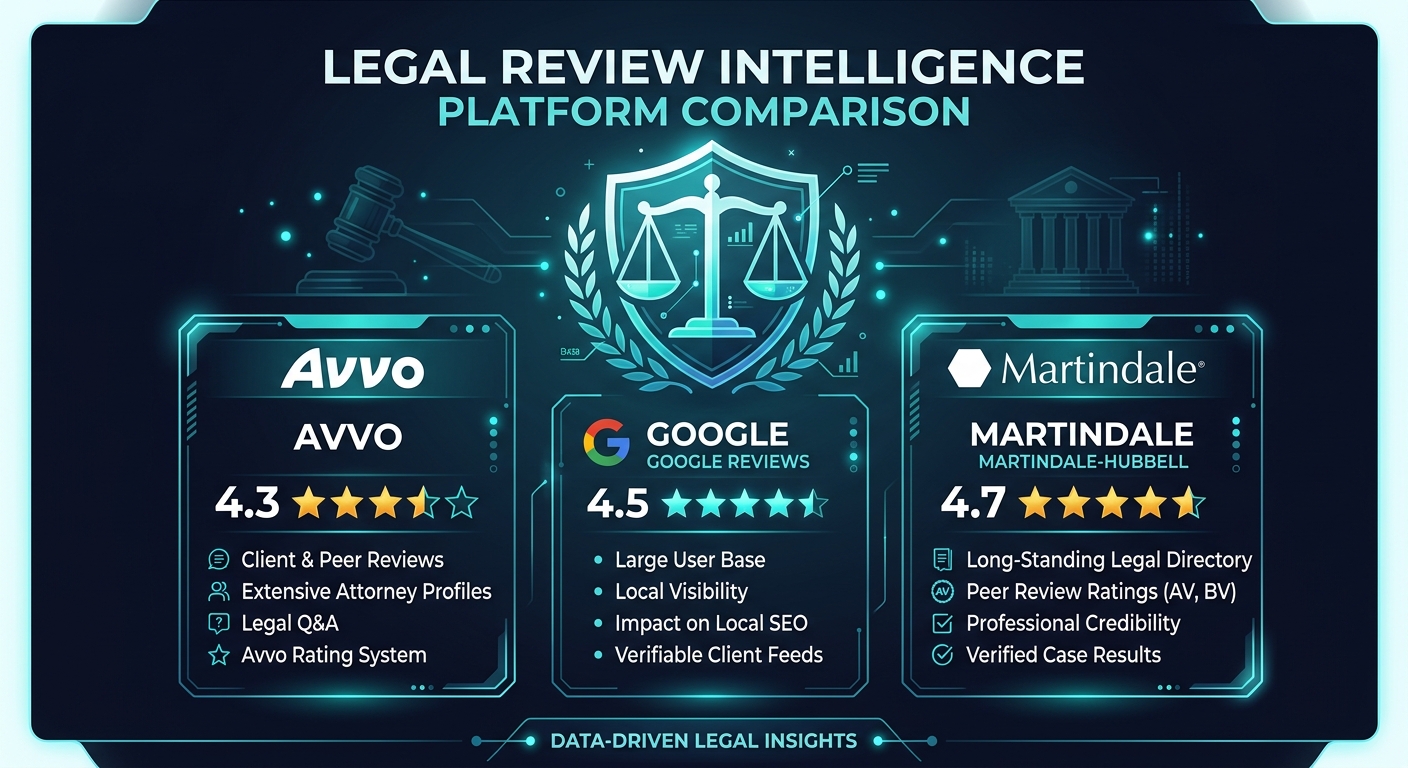
How Avvo's Rating System Actually Works
Most lawyers misunderstand the Avvo rating, and that misunderstanding leads to misallocated effort. Let us clarify.
The Avvo Rating (1-10 Scale)
The Avvo rating is an algorithmically generated score from 1.0 to 10.0. It is not an average of client reviews. The algorithm weighs multiple factors:
- Years in practice — more experience generally increases the score
- Disciplinary record — any bar disciplinary actions severely reduce the score
- Professional achievements — awards, honors, speaking engagements, publications
- Peer endorsements — endorsements from other attorneys on the platform
- Industry recognition — board certifications, legal associations
- Profile completeness — fully completed profiles score higher than sparse ones
- Client reviews — positive reviews contribute to the score, but are only one factor
A newly licensed attorney with zero reviews might have an Avvo rating of 5.0 purely based on education and bar membership. A 20-year veteran with many peer endorsements might have a 9.5 even with only a handful of client reviews.
Client Review Stars (1-5 Scale)
Separately from the Avvo rating, clients leave traditional star reviews (1-5) with written commentary. These reviews appear on the attorney's profile and are what prospective clients actually read when evaluating whether to hire the lawyer.
Why Both Matter
The Avvo rating determines visibility — how prominently your profile appears in Avvo search results and directory listings. Client review stars determine conversion — whether a prospective client who finds your profile actually contacts you.
A lawyer with a 9.0 Avvo rating and no client reviews gets visibility but generates fewer inquiries. A lawyer with a 6.0 Avvo rating and 50 glowing client reviews gets less visibility but converts at a higher rate among visitors who do find them.
"The Avvo rating opens the door. Client reviews close the deal. Optimizing one without the other is like running ads to a landing page with no testimonials — traffic without conversion."
The optimal strategy is to build both: raise your algorithmic rating through profile completeness, peer endorsements, and professional achievements, while simultaneously generating authentic client reviews that convert profile visitors into consultations.
Bar Ethics and Review Solicitation: The Legal Minefield
This is where attorney review management diverges from every other industry. Lawyers are bound by state bar ethics rules that restrict how they can solicit client feedback, and violating these rules can result in disciplinary action up to and including disbarment.
The ABA Model Rules
The American Bar Association Model Rule 7.1 prohibits false or misleading communications about legal services. Model Rule 7.2 governs advertising, including client testimonials and endorsements. While these model rules do not specifically address online reviews, most state bars have issued guidance interpreting them in the context of review platforms.
State-by-State Variations
Ethics rules vary by state, but the general consensus includes:
Generally Permitted: - Asking clients to leave a review on Avvo, Google, or other platforms (in most states) - Sending a post-engagement email with a link to your review profile - Displaying review links on your website - Thanking clients for positive reviews
Generally Prohibited: - Offering any compensation, discount, or incentive for reviews (this is a bright-line rule in virtually every state) - Asking clients to leave specifically positive reviews (you must ask for honest feedback, not favorable feedback) - Pressuring clients, particularly during active representation - Ghost-writing reviews for clients or having staff write reviews posing as clients
Gray Areas (check your state bar): - Asking for reviews during active representation (some states say wait until after the matter concludes) - Using automated review request software that sends templated solicitation emails - Selectively asking only clients you believe will leave positive reviews (some bars view this as potentially misleading) - Responding to negative reviews with case-specific details (implicates client confidentiality)
The Confidentiality Constraint
Unlike healthcare's HIPAA constraints, attorney-client privilege creates an even stricter limitation on review responses. A lawyer cannot disclose any information relating to the representation without the client's informed consent — and a client posting a negative review does not constitute consent for the lawyer to discuss case details.
This means that when a former client leaves a review saying "my lawyer lost my case and never returned my calls," you cannot respond with "the case was dismissed on procedural grounds and I returned every call within 24 hours" — even if that is factually accurate. Doing so would violate your duty of confidentiality.
Safe Review Response Templates
For positive reviews: "Thank you for taking the time to share your experience. It was a privilege to assist with your legal matter, and I'm glad the outcome met your expectations."
For negative reviews: "Thank you for your feedback. I take client satisfaction very seriously. Due to professional obligations regarding client confidentiality, I am unable to discuss the specifics of any legal matter publicly. I would welcome the opportunity to address your concerns directly — please contact my office at [phone/email]."
Notice that both responses avoid confirming case details, outcomes, or even the nature of the legal matter.
Client Sentiment Themes by Practice Area
Different practice areas generate different review themes because the client experience, emotional stakes, and outcome expectations vary dramatically.
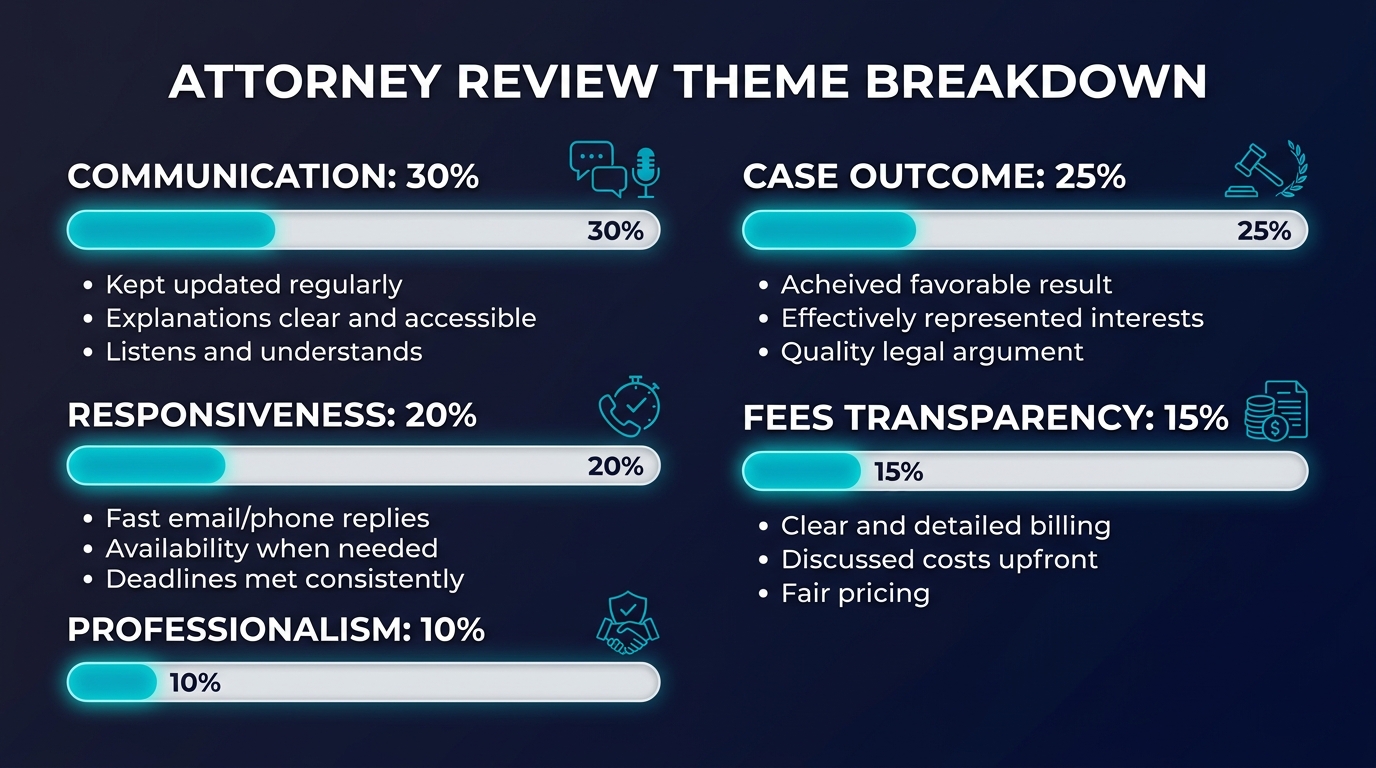
| Practice Area | Top Positive Themes | Top Negative Themes | Emotional Driver |
|---|---|---|---|
| Family Law (Divorce) | Empathy, realistic expectations, custody advocacy | Cost surprises, case duration, emotional insensitivity | Fear and vulnerability |
| Criminal Defense | Availability (24/7), courtroom skill, charge reduction | Communication gaps, unexpected costs, outcome disappointment | Desperation and urgency |
| Personal Injury | Settlement amount, contingency fee clarity, medical coordination | Case duration, communication frequency, settlement below expectations | Financial stress and physical pain |
| Estate Planning | Thoroughness, plain-language explanations, document organization | Hidden fees, generic templates, slow turnaround | Legacy anxiety |
| Immigration | Cultural sensitivity, process clarity, deadline reliability | Processing delays (often out of attorney's control), cost escalation, communication barriers | Existential uncertainty |
| Business/Corporate | Efficiency, strategic insight, availability | Hourly billing surprise, junior associate delegation, slow response | Financial stakes and time pressure |
| Real Estate | Transaction smoothness, title issue resolution, closing timeliness | Missed deadlines, poor communication near closing, unexpected fees | Transaction anxiety |
| Employment Law | Employee advocacy, employer negotiation skill, documentation rigor | Case screening rejection, communication delays, outcome below expectations | Workplace injustice |
Using Theme Analysis Strategically
Knowing your practice area's themes lets you do two things:
1. Proactively address likely complaints. If you are a personal injury attorney, you know that case duration and communication frequency are your top negative review risks. Implementing a monthly case status update process costs almost nothing but directly addresses the most common complaint theme.
2. Market your strengths in the language clients use. If your reviews consistently praise "realistic expectations" and "honest about the odds," those phrases belong on your website, in your intake materials, and in your advertising. Review language is the most authentic marketing copy available because it comes directly from satisfied clients.
For a deeper look at using review language for marketing, see our guide on using review data for marketing copy.
Competitive Analysis for Law Firms
Legal competitive analysis through reviews is particularly valuable because law firms compete for clients within defined practice areas and geographic jurisdictions.
Identifying Your Competitive Set
Your Avvo competitors are attorneys who: - Practice the same primary area of law - Serve the same geographic market - Target the same client profile (individuals vs. businesses, complexity level) - Appear in the same Avvo search results
Search Avvo for your primary practice area in your city. The attorneys appearing in the top 10-15 results are your direct competitors for client inquiries.
The Competitive Analysis Matrix
For each competitor, capture:
| Metric | You | Competitor A | Competitor B | Competitor C |
|---|---|---|---|---|
| Avvo Rating | 8.5 | 9.2 | 7.8 | 8.9 |
| Client Reviews (count) | 23 | 67 | 12 | 45 |
| Average Client Star Rating | 4.7 | 4.5 | 4.9 | 4.3 |
| Peer Endorsements | 15 | 42 | 8 | 31 |
| Top Positive Theme | Personal attention | Courtroom success | Thoroughness | Availability |
| Top Negative Theme | Response time | Cost | Limited availability | Staff issues |
| Review Velocity (per month) | 1-2 | 4-5 | <1 | 2-3 |
See What Your Reviews Really Say
Paste any product URL and get an AI-powered SWOT analysis in under 60 seconds.
Try It Free →Strategic Insights From the Data
This matrix reveals several actionable insights:
Competitor A has the highest Avvo rating and most reviews but a lower average star rating (4.5). This attorney is winning on volume and platform optimization but may have client satisfaction issues. Read their negative reviews — if there is a consistent theme (cost, communication, etc.), that is your opportunity to differentiate.
Competitor B has the highest star rating (4.9) but the fewest reviews (12) and lowest Avvo rating (7.8). This attorney provides excellent client experience but has not invested in review generation or Avvo profile optimization. They are vulnerable — a few negative reviews could disproportionately impact their small review base.
Your position (8.5 Avvo, 23 reviews, 4.7 stars) is solid but not dominant. The gap between you and Competitor A is primarily in review count and peer endorsements — both of which are actionable. A focused effort on generating 3-4 new client reviews per month and requesting 2-3 peer endorsements per quarter could close the gap within 6 months.
Building Your Avvo Review Intelligence System
For Solo Practitioners
Monthly (30 minutes): - Check all new reviews on Avvo, Google, and any other active platform - Respond to every review within 48 hours using the ethics-compliant templates - Run a Sentimyne analysis on your Avvo and Google profiles to identify theme trends - Note any operational changes suggested by review themes
Quarterly (1 hour): - Full competitive analysis using the matrix above - Review your Avvo profile completeness and update professional achievements, publications, and associations - Request 2-3 peer endorsements from attorneys you have worked with or opposing counsel you respect - Identify one practice improvement based on review themes from the past quarter
Sentimyne's free tier (2 analyses per month) is sufficient for a solo practitioner monitoring their own profile and one competitor. Pro ($29/month) unlocks unlimited analyses for attorneys who want to track multiple competitors or monitor reviews across Google, Avvo, Lawyers.com, and Martindale-Hubbell simultaneously.
For Law Firms (Multi-Attorney)
Weekly (15 minutes per attorney): - Assign a marketing coordinator or office manager to monitor reviews for all attorneys - Flag any negative reviews for immediate response by the managing partner - Track review themes by attorney — if one attorney generates consistent negative themes, that is a coaching opportunity
Monthly (1 hour): - Firm-wide review analysis across all platforms and all attorneys - Compare individual attorney review profiles to identify best practices and improvement areas - Share positive review themes in team meetings to reinforce desired behaviors
Quarterly (2 hours): - Full competitive benchmarking against rival firms - Correlate review themes with client intake data — are the practice areas generating the most reviews also the most profitable? - Strategic planning: use review intelligence to inform hiring, marketing, and practice area expansion decisions
The Sentimyne Team plan ($49/month) supports collaborative analysis across multiple attorney profiles and platforms — essential for firms managing the reputation of 3 or more attorneys.
Review Generation Without Crossing Ethics Lines
Given the bar ethics constraints, here is how to systematically generate more reviews while staying in compliance:
The Post-Engagement Ask
The safest time to request a review is after the legal matter has concluded. Send a brief, personal email:
"Dear [Client Name], now that your [general description — e.g., 'matter'] has been resolved, I wanted to thank you for trusting our firm. If you found the experience positive, an honest review on [Avvo/Google] would help other people in similar situations find qualified legal representation. Here is the direct link: [URL]. Of course, there is no obligation, and I value your feedback regardless of whether it is positive or constructive."
Key elements: the ask comes after the matter concludes, it requests honest feedback (not positive feedback), it includes no incentive, and it acknowledges that negative feedback is also welcome.
Systematizing Without Automating
Many bar associations are cautious about fully automated review request systems. A safer approach:
- Add a review request step to your case-closing checklist
- The responsible attorney or paralegal sends a personalized (not templated) email within one week of matter conclusion
- Include direct links to your Avvo profile and Google Business Profile
- Track which clients were asked and which left reviews (to avoid repeat asking)
- Never follow up more than once
Building Peer Endorsements
Avvo peer endorsements significantly impact your algorithmic rating. These are endorsements from other licensed attorneys who can vouch for your skill, knowledge, and professionalism.
Appropriate sources for peer endorsements: - Attorneys you have co-counseled with - Opposing counsel who respect your professionalism - Attorneys in complementary practice areas who refer clients to you - Law school classmates now in practice - Bar association committee colleagues
Simply ask: "Would you be willing to write a brief Avvo endorsement based on your experience working with me? I would be happy to reciprocate." Reciprocal endorsements are permitted and common.
Specialty-Specific Strategies
Family Law
Family law reviews are the most emotionally charged in the legal profession. Clients going through divorce, custody battles, and domestic disputes are under extreme stress, and their reviews reflect that emotional state.
Key strategy: Set expectations early and often. The number one driver of negative family law reviews is unmet expectations about timeline, cost, and outcome. During intake, provide written estimates for timeline and cost ranges. Send monthly case status updates even when there is nothing new to report — the silence itself generates anxiety and negative reviews.
Criminal Defense
Criminal defense reviews split into two categories: clients who were acquitted or had charges reduced (enthusiastic reviews) and clients who were convicted (angry reviews, often regardless of the attorney's performance).
Key strategy: Emphasize process over outcome. Market and communicate your accessibility, communication style, and advocacy during the case. Clients who feel well-supported during the process leave better reviews even when the outcome is disappointing. The reviews that mention "was there for me every step" and "explained everything" come from attorneys who invested in client communication.
Personal Injury
Personal injury reviews are dominated by one number: the settlement amount. Clients who received a settlement they perceived as fair leave glowing reviews. Clients who expected more leave negative reviews.
Key strategy: Manage settlement expectations from the first consultation. Provide a realistic range early and update it as the case develops. The most dangerous gap in personal injury is between the client's expected settlement and the actual settlement — narrow that gap through consistent communication and your review profile improves.
For additional industry-specific review strategies, see our guides on restaurant review analysis, automotive dealership review analysis, and real estate review analysis.
Frequently Asked Questions
How does the Avvo rating differ from client review stars?
The Avvo rating is an algorithmically calculated score from 1 to 10 based on multiple factors including years of experience, disciplinary history, professional achievements, peer endorsements, profile completeness, and client reviews. Client review stars are the traditional 1 to 5 star ratings that clients leave based on their experience. A lawyer can have a high Avvo rating with few client reviews (based on experience and credentials) or a low Avvo rating with excellent client reviews (if they are newly licensed). Both metrics matter: the Avvo rating drives search visibility within the platform, while client review stars drive prospective client conversion.
Can lawyers ask clients for Avvo reviews without violating bar ethics rules?
In most states, yes — but with important constraints. You may ask for honest reviews but cannot request specifically positive reviews. You cannot offer any incentive, discount, or compensation in exchange for a review. Most ethics opinions recommend waiting until after the legal matter has concluded before making the ask. You should never pressure a client during active representation. The safest approach is a brief, personal email sent after the matter closes that requests honest feedback and includes a direct link to your review profile. Check your specific state bar's ethics opinions on attorney advertising and solicitation for jurisdiction-specific guidance.
How should lawyers handle false or defamatory reviews on Avvo?
First, determine whether the review is genuinely false (the reviewer was never a client, the facts are fabricated) versus unflattering but based on a real experience. For genuinely false reviews, report the review to Avvo's content moderation team with documentation that the reviewer was never a client. Avvo will investigate and may remove reviews that violate their terms of service. For reviews that are defamatory — containing false statements of fact that damage your reputation — consult with a defamation attorney about your options. Do not respond publicly with case details, as this would violate client confidentiality even if the reviewer is not actually a client. Document everything and pursue removal through proper channels.
Which review platform matters most for lawyers besides Avvo?
Google Business Profile is the second most important platform for most attorneys. While Avvo is the largest legal-specific review site, many prospective clients begin their search on Google rather than on Avvo directly. A strong Google profile with reviews ensures you appear in local search results and Google Maps queries like "divorce lawyer near me." For certain practice areas, additional platforms matter: Lawyers.com and Martindale-Hubbell carry weight with sophisticated clients, while Yelp can drive inquiries for consumer-facing specialties like personal injury, immigration, and criminal defense. Monitor at least Avvo and Google; add other platforms based on your practice area and market.
How long does it take to see practice growth from review improvement?
Most attorneys report measurable increases in inquiry volume within 3 to 6 months of implementing a systematic review strategy. The timeline depends on your starting position: if you have zero reviews, the first 10 to 15 reviews create the biggest jump in prospective client confidence. If you already have 30 or more reviews, improvements in average star rating and review recency matter more than additional volume. Competitive analysis accelerates results because it helps you identify and exploit specific gaps in your competitors' review profiles. Attorneys who combine review generation with Avvo profile optimization (peer endorsements, professional achievements, profile completeness) see faster improvements in both visibility and conversion.
Ready to try AI-powered review analysis?
Get 2 free SWOT reports per month. No credit card required.
Start FreeRelated Articles
Trust and competence are the only metrics that matter in legal services. Learn how to analyse Avvo, Google, and Martindale-Hubbell reviews to assess attorney credentials, compare law firms, identify red flags in client feedback, and build transparent evaluation frameworks for legal service quality.
Discord Community Sentiment Analysis: Mining Member Feedback From Private CommunitiesDiscord communities are invisible to traditional review platforms. Learn how to systematically extract and analyze member sentiment from channels to detect engagement churn, identify friction points, and drive community growth.
Luxury Brand Review Analysis: Understanding High-End Customer Expectations and FeedbackLuxury brands operate with different customer expectations. Learn how to analyze reviews on specialty platforms, separate outcome from process feedback, and detect quality deterioration in high-margin segments.