Legal Services Review Analysis: Auditing Law Firms, Attorneys, and Legal Practices Through Client Feedback
Trust and competence are the only metrics that matter in legal services. Learn how to analyse Avvo, Google, and Martindale-Hubbell reviews to assess attorney credentials, compare law firms, identify red flags in client feedback, and build transparent evaluation frameworks for legal service quality.

# Legal Services Review Analysis: Auditing Law Firms, Attorneys, and Legal Practices Through Client Feedback

The legal market is broken by information asymmetry. Clients hire attorneys based on reputation (often undeserved), bar association credentials (which only measure minimum competence), and word of mouth (which reaches 2-3 people). Meanwhile, dissatisfied clients post reviews on Avvo, Google, and Martindale-Hubbell — feedback that influences future clients more than any marketing material.
Yet most law firms do not systematically analyse their reviews. They treat reviews as reputation management problems ("get that bad review removed") rather than product quality signals ("why do clients consistently complain about billing transparency?").
This creates an asymmetry: informed consumers read reviews. Firms ignore them. The market learns to distrust firms that fight feedback and reward firms that respond thoughtfully.
This guide shows you how to analyse legal service reviews like any other professional services feedback, and what it reveals about practice quality.
Why legal services reviews are structurally different
Legal feedback has unique properties that reshape how you should analyse it:
1. Outcome bias dominates perception
A client who wins their case rates a firm 5 stars even if the attorney was unreachable and billing was opaque. A client who loses rates 1 star even if the attorney was brilliant and transparent. Unlike software review analysis, outcome quality is outside the firm's control.
This means you must separate outcome feedback from process feedback. Process feedback reveals the firm's actual quality.
2. Specialisation creates fragmentation
A personal injury firm's client reviews tell you nothing about a patent firm's quality. Even within practice areas, a firm specialising in copyright disputes may fail at trademark registrations. Reviews must be filtered by practice area.
3. Client sophistication varies wildly
A Fortune 500 general counsel reviewing their outside counsel has vastly different standards than an individual filing for bankruptcy. Both are equally valid feedback, but they reveal different things. A "bad" review from a novice might mean good value (they wanted something simple and got that). A "bad" review from a corporate buyer might mean incompetence in complex matters.
4. Feedback lag is severe
A legal matter can take 2-3 years to resolve. The review appears only after conclusion or abandonment. You cannot rely on review volume for real-time quality assessment. A firm with 10 reviews per year might be handling 500 matters annually; most do not reach review platforms.
5. Confidentiality constraints reviews
Clients cannot discuss case details. Reviews often lack specificity. "Excellent representation" or "handled everything smoothly" tells you sentiment, not competence. Contrast this with SaaS review analysis, where users describe exact features and usage.
The legal review ecosystem: platforms and signal quality
Avvo (avvo.com)
Signal quality: HIGH - Verified by bar association membership - 1-10 scale with detailed rubric - Community Q&A reputation component - Specialisation categorization
Bias: Attracts proactive attorneys (those who care about online presence). Underrepresents established firms ignoring digital reputation. Results skew toward younger, tech-forward practices.
Google Reviews
Signal quality: MEDIUM-HIGH - General audience, not lawyer-specific - Authentic (clients less aware of marketing optics) - Lower barrier to entry (any client with Gmail) - Visible in Google Maps for location-based searches
Bias: Clients who go out of their way to leave reviews (either very satisfied or very angry). Often focused on receptionist friendliness and office experience, not legal quality.
Martindale-Hubbell (martindale.com)
Signal quality: MEDIUM - Peer-reviewed ratings alongside client reviews - Lawyer-to-lawyer credibility - Long-form client narratives - Rating by years of experience
Bias: Expensive (firms pay to appear). Includes peer endorsements (fellow attorneys). Underrepresents soloists and new practices that cannot afford the fee.
Bar Association directories
Signal quality: LOW (for service quality) - Verification of good standing and credentials - No performance or satisfaction data - Minimal feedback mechanism
Use: Verification tool, not quality signal.
Legal service review aggregators (LegalZoom, Rocket Lawyer, Avvo's attorney matching)
Signal quality: MEDIUM - Curated, not raw reviews - Platform incentive to screen for legitimacy - Narrow practice area (LegalZoom serves DIY legal, not litigation)
Bias: Selection bias toward standardised legal services (contracts, incorporation, simple divorces). Complex litigation reviews underrepresented.
Systematic legal services review analysis framework
Step 1: Scope definition and filtering
For a law firm, define your analysis scope:
By practice area: - Criminal defence, personal injury, family law, intellectual property, corporate, real estate, tax, immigration, bankruptcy
By matter complexity: - Simple matters (incorporation, simple will, uncontested divorce): expect 3-6 month resolution - Moderate matters (contract disputes, employment claims): expect 6-18 month resolution - Complex matters (litigation, IP disputes, M&A): expect 18+ months
See What Your Reviews Really Say
Paste any product URL and get an AI-powered SWOT analysis in under 60 seconds.
Try It Free →By client sophistication: - Individual consumers (DIY baseline, high outcome bias) - Small business owners (higher standards, expect clear communication) - Corporate buyers (demand transparent processes, timely delivery)
For each segment, establish separate review baselines. A personal injury firm serving individuals should not be compared to the same firm's corporate litigation work.
Step 2: Review collection and enrichment
Gather reviews from all major platforms:
| Platform | Collection method | Data enrichment |
|---|---|---|
| Avvo | API or manual (limit 50+) | Specialisation tag, rating date, helpful votes |
| Google My Business API | Star rating, response history | |
| Martindale-Hubbell | Web scraping or manual | Years of practice, peer endorsements, rating date |
| Bar associations | Member directories | Bar standing, disciplinary history, practice areas |
For each review, extract: - Star rating (1-5 or 1-10) - Text content - Posting date - Author details (if available: repeat client, corporate buyer, individual) - Firm response (if any) - Helpful/unhelpful votes
Step 3: Sentiment polarity and outcome separation
Classify reviews as:
Outcome-positive, process-positive: "My attorney handled my case brilliantly, kept me informed every step, and the case went exactly as expected. Highly recommend." - Signal: High firm quality - Action: Highlight in marketing
Outcome-positive, process-negative: "We won the case, but the attorney was unreachable for months, billing was a nightmare, and we only heard from the firm when they needed something." - Signal: Lucky outcome masks poor process. Risky for client retention. - Action: Process improvement required
Outcome-negative, process-positive: "My attorney did everything right, explained each step clearly, but the other side had a stronger case. Lost, but no regrets about the representation." - Signal: High firm quality, appropriate expectation-setting - Action: Neutral feedback (legal matter outcome, not firm quality)
Outcome-negative, process-negative: "Lost the case, never heard from my attorney, billing was outrageous, and I felt abandoned." - Signal: Low firm quality + adverse outcome = high dissatisfaction - Action: Process and communication improvement required
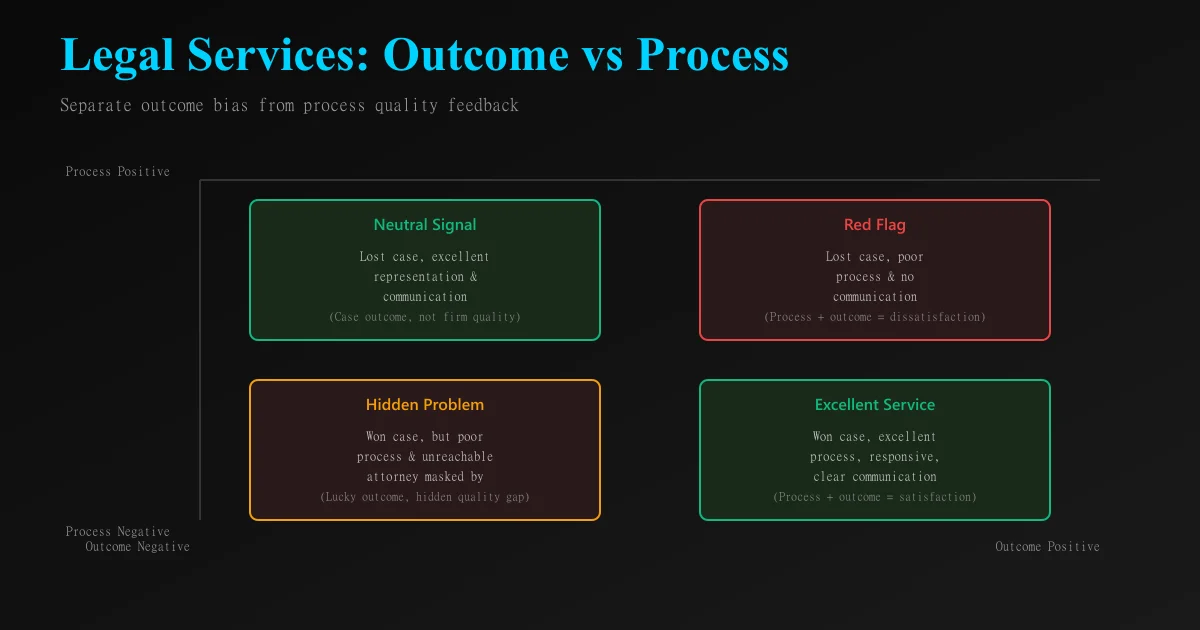
Group reviews by outcome-process quadrant. Outcome-negative process-positive feedback does not signal firm quality problems. Outcome-positive process-negative feedback signals hidden problems.
Step 4: Extract process feedback clusters
Within process-focused feedback, identify patterns:
| Process dimension | Positive signals | Red flags |
|---|---|---|
| Communication | "Responsive," "kept me informed," "returned calls quickly" | "Unreachable," "long delays between updates," "never explained strategy" |
| Billing transparency | "Costs were exactly as quoted," "clear invoicing," "reasonable" | "Surprise bills," "vague invoicing," "outrageous final bill" |
| Competence | "Knew the law," "strategic approach," "strong in court" | "Made basic mistakes," "unprepared," "didn't understand area" |
| Professional conduct | "Respectful," "took me seriously," "considered my concerns" | "Rude," "rushed," "dismissive of client questions" |
| Timeline clarity | "Explained realistic timeframe," "delivered on schedule" | "Vague about timeline," "case dragged on," "constantly delayed" |
For each process dimension, calculate: - Frequency (how many reviews mention this factor) - Polarity ratio (positive % vs negative % for this factor) - Trend (is this getting better or worse month-to-month)
Step 5: Red flag severity assessment
Certain feedback patterns require immediate attention:
| Red flag | Severity | Indication |
|---|---|---|
| Repeated billing surprises | CRITICAL | Systemic process failure, client loss imminent |
| Communication unresponsiveness | HIGH | Practice management problem, client relationship collapse |
| Competence gaps in claimed specialty | CRITICAL | Legal liability, disciplinary risk |
| Professional conduct complaints | CRITICAL | Potential bar association violation |
| Client abandonment stories | HIGH | Reputational damage, direct liability |
| Hidden costs or scope creep | HIGH | Trust erosion, word-of-mouth damage |
| Disciplinary history mentions | CRITICAL | Verify bar standing immediately |
Legal services vs professional services vs SaaS review analysis: comparison
Legal feedback differs from professional services like accounting and software:
Legal-specific challenges: - Outcome bias dominates (outside firm control) - Confidentiality constraints limit feedback detail - Small review volume (matters take months, client sees one outcome) - Specialisation fragmentation (one practice area ≠ another)
Legal-specific advantages: - High trust dependency (clients read reviews carefully before hiring) - Outcome clarity (case won or lost, matter resolved or not) - Professional standards (bar association provides quality baseline)
Legal review analysis is most similar to healthcare provider reviews — outcome bias is also severe, specialisation matters, and feedback is outcome-dependent.
Building a legal services feedback loop
For law firms: client satisfaction dashboard
Track monthly: - Average rating by practice area (separate criminal from civil from corporate) - Responsiveness score (mentions of timely communication / total reviews) - Billing clarity score (no surprises / total reviews) - Professional conduct score (respectful treatment / total reviews) - Outcome success rate (case/matter won / total reviews) — with caveat that this reflects case strength, not firm quality
Compare against practice area benchmarks. A criminal defence firm with 80% outcome success rate is exceptional. A corporate M&A firm with 80% rate is normal. Normalise benchmarks.
For legal service platforms: attorney quality ranking
If you are building a legal service marketplace or aggregator:
- Verify bar standing (check state bar database for each attorney)
- Filter reviews by practice area (only count reviews in claimed specialisation)
- Separate outcome-dependent feedback (weight process feedback 70%, outcome feedback 30%)
- Calculate process quality score (communication, billing, professionalism, timeline)
- Display specialisation depth (how many reviews in each practice area)
- Show outcome statistics with caveats ("Won 65% of cases handled; case outcome depends on case facts, not attorney skill")
Common legal services review analysis mistakes
Mistake 1: Treating all negative feedback equally A client angry about losing their case ≠ a client angry about hidden billing. Separate outcome-dependent feedback (neutral) from process feedback (actionable). A 3-star review from an outcome loss but 5-star on process quality is actually a sign of firm excellence.
Mistake 2: Ignoring specialisation A firm brilliant at corporate M&A may be mediocre at tax planning. Reviews must be segmented by practice area before calculating quality scores. A firm's overall rating collapses if you average excellent M&A reviews with poor tax reviews.
Mistake 3: Treating review volume as quality signal Avvo-active attorneys and firms get more reviews (they're marketing-savvy). Quality firms that ignore reviews may have fewer reviews but higher satisfaction among those who bother to leave feedback. Volume without context is meaningless.
Mistake 4: Overlooking firm responses to reviews How a firm responds to criticism is often more important than the criticism itself. A firm that apologises, addresses the concern, and invites dialogue demonstrates responsiveness. A firm that ignores criticism or gets defensive confirms the problem.
Mistake 5: Failing to verify bar standing and disciplinary history Before trusting any review, verify the attorney is in good standing and has no unresolved disciplinary complaints. A positive review from a disbarred attorney is worthless. Many legal review platforms hide disciplinary information; you must check state bar databases directly.
Ready to try AI-powered review analysis?
Get 2 free SWOT reports per month. No credit card required.
Start FreeRelated Articles
A legal industry-specific guide to analyzing Avvo reviews, understanding Avvo's algorithmic rating system, navigating bar ethics constraints on review solicitation, identifying client sentiment themes by practice area, and using competitive analysis to grow your practice.
Discord Community Sentiment Analysis: Mining Member Feedback From Private CommunitiesDiscord communities are invisible to traditional review platforms. Learn how to systematically extract and analyze member sentiment from channels to detect engagement churn, identify friction points, and drive community growth.
Luxury Brand Review Analysis: Understanding High-End Customer Expectations and FeedbackLuxury brands operate with different customer expectations. Learn how to analyze reviews on specialty platforms, separate outcome from process feedback, and detect quality deterioration in high-margin segments.