Review Analysis for the Pet Industry: From Pet Food Subscriptions to Vet Clinics
The pet industry hit $150B in the US alone, with pet parents treating reviews as seriously as they'd treat advice for a human child. Learn how pet brands, vets, groomers, and subscription boxes can analyse reviews to reduce churn, improve products, and win trust in the most emotionally-driven market online.
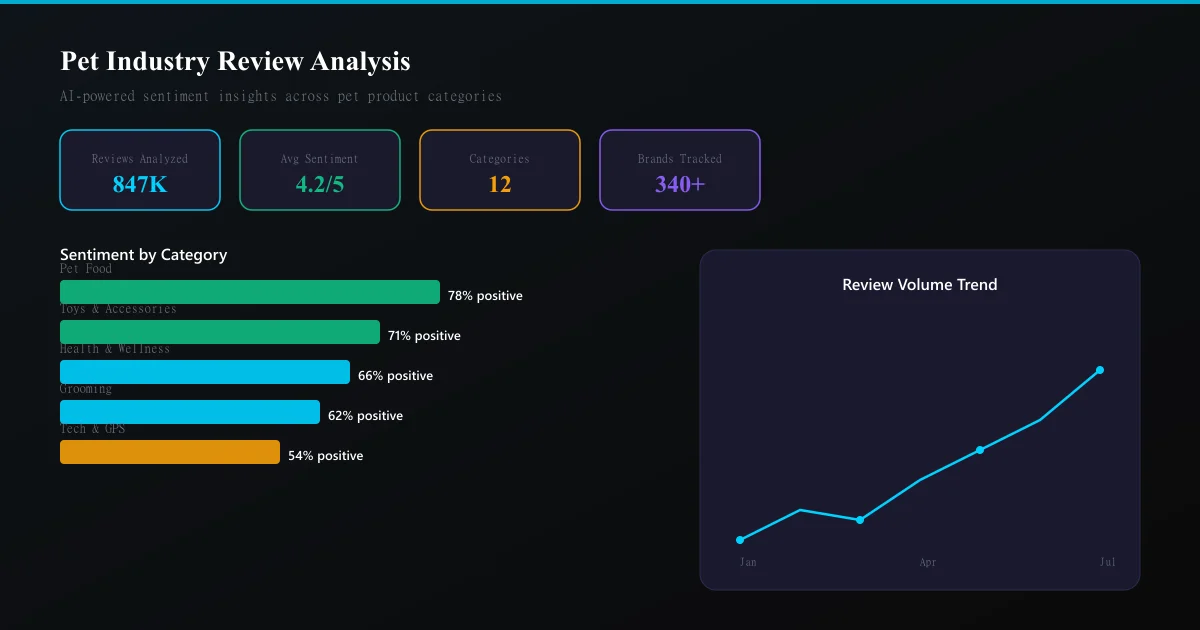
Pet parents don't just buy products for their animals — they agonise over them. A human might grab the cheapest shampoo on the shelf for themselves, but they'll spend 45 minutes reading reviews before choosing a shampoo for their dog. The emotional stakes in pet purchasing are unlike any other consumer category, and that emotional intensity flows directly into the reviews they write.
The US pet industry surpassed $150 billion in 2025, growing at 6–8% annually. Within this market, reviews carry disproportionate influence because the "end user" (the pet) can't provide feedback — the owner must interpret their pet's experience and trust other owners' interpretations. This creates a review ecosystem that's uniquely rich in observational detail, emotionally charged, and decision-critical for buyers.
Why Pet Industry Reviews Are Different
The Proxy Problem
In every other product category, the reviewer is also the user. Pet reviews break this pattern — the reviewer is describing their pet's experience through observation and inference. "My dog loves this food" actually means "My dog eats this food eagerly and seems healthy after eating it." The reviewer is a proxy observer, not a direct experiencer.
This proxy dynamic means pet reviews contain: - Behavioural observations — "He scratches less," "She has more energy," "He refuses to eat it" - Health outcome data — "Coat is shinier after 3 weeks," "Digestive issues cleared up," "Caused vomiting" - Comparative behaviour — "Likes this more than [Previous Brand]," "Won't touch it after switching from [Competitor]" - Emotional interpretation — "She seems happier," "He looks forward to mealtime now"
For sentiment analysis, this proxy language requires calibration. "My dog won't eat it" is functionally equivalent to a 1-star product failure, even though the reviewer's tone might be measured rather than angry.
The Health Sensitivity
Pet health reviews carry a unique weight. A review that says "This food caused my cat to develop kidney issues" — whether the causation is accurate or not — generates outsized fear in prospective buyers. Health-related negative reviews in pet products are 3–5× more damaging to conversion than equivalent negatives in non-health categories because pet parents apply precautionary principle thinking: "I'd rather avoid the risk than save money."
This means: - One health-related negative review can outweigh 50 positives in terms of purchase-decision impact - Response strategy must prioritise health claims — responding to these reviews requires specific, evidence-based language - Ingredient transparency in review responses builds disproportionate trust
The Breed/Species Specificity
"Great for large breeds" is irrelevant to a Chihuahua owner. "Perfect for indoor cats" doesn't help someone with barn cats. Pet reviews are inherently segmented by animal type, breed, size, age, and health condition — and buyers filter aggressively for relevance to their specific pet.
This natural segmentation makes aspect-based sentiment analysis particularly valuable in the pet industry. Breaking reviews down by pet-type mention allows brands to understand which products work for which animals and market accordingly.
Sector-by-Sector Analysis
Pet Food & Nutrition
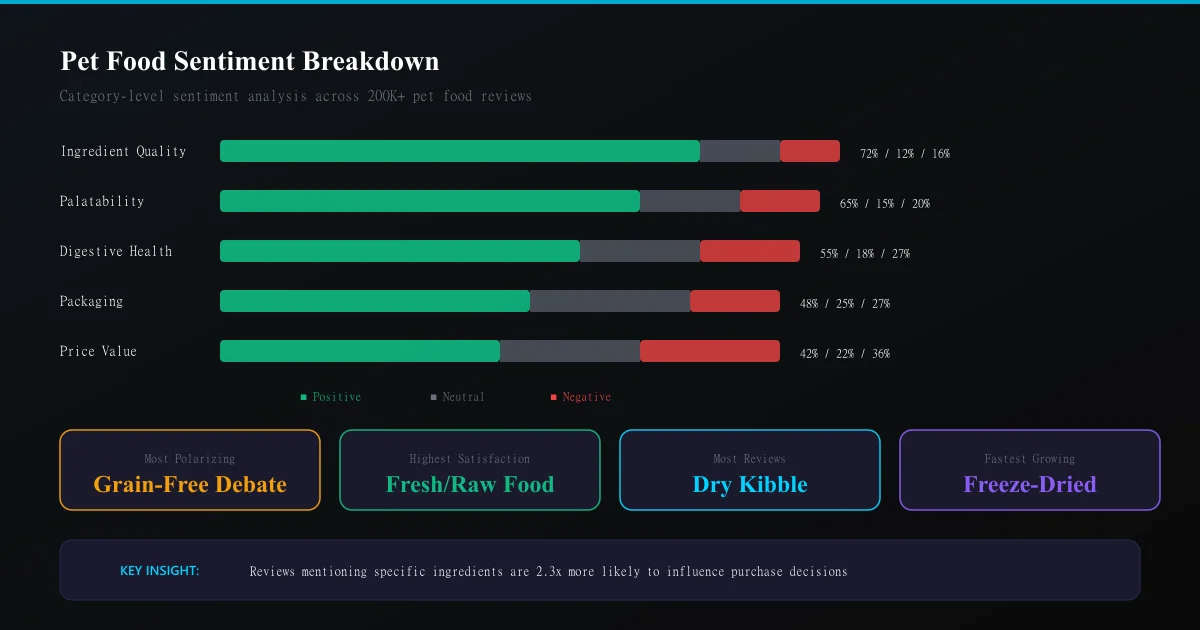
Pet food is the largest segment of the pet industry (~$60B in the US) and the most review-intensive. Key review themes:
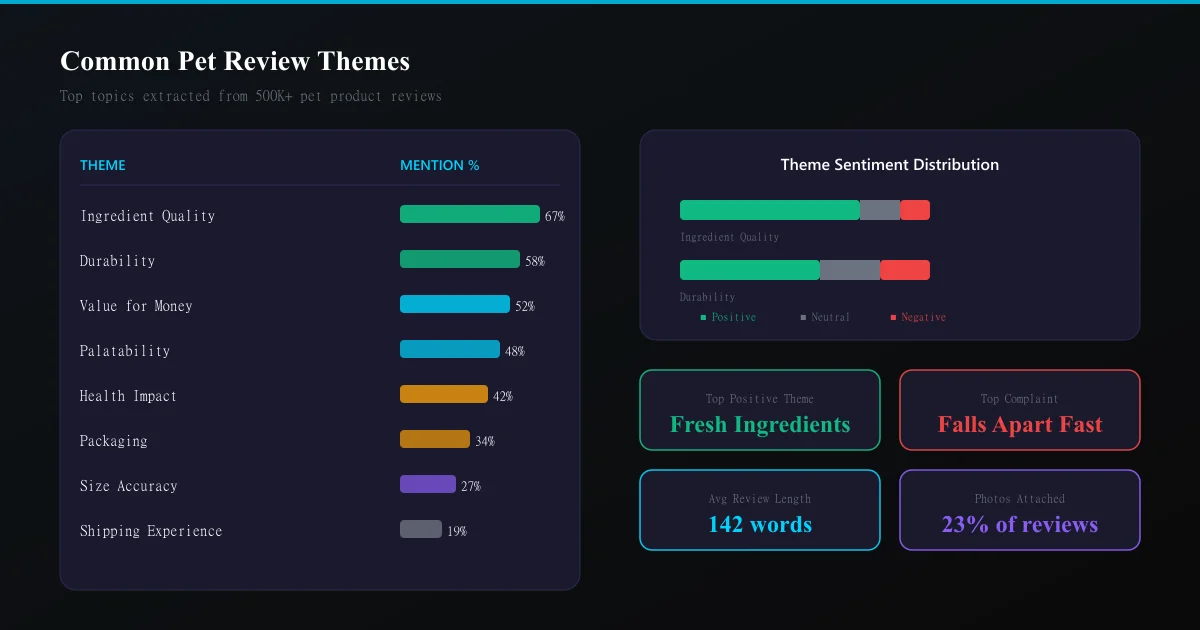
Palatability — Does the pet eat it willingly? Refusal is the #1 complaint in pet food reviews. Brands that score poorly on palatability in reviews lose repeat purchases regardless of nutritional quality.
Ingredient quality — Pet parents increasingly read ingredient lists and discuss them in reviews. "First ingredient is real chicken" generates positive mentions. "Too much filler/grain" generates negatives. This theme has grown 40%+ in review frequency since 2020 as premiumisation accelerates.
Health outcomes — Coat quality, energy levels, digestive health, weight management, and allergy relief. These are mentioned in reviews weeks or months after purchase, making them the most delayed but most valuable feedback signal.
Price/value — Premium pet food ($4–7/lb) faces constant value scrutiny. Reviews that say "expensive but worth it for the health benefits" are positive signals. Reviews that say "too expensive for what it is" indicate pricing pressure.
Consistency — Pet food reviews frequently mention formula changes: "They changed the recipe and now my dog won't eat it." Product consistency is a make-or-break theme unique to pet food — pets are more sensitive to taste/texture changes than their owners are to packaging changes.
Veterinary Clinics
Vet clinic reviews look similar to healthcare reviews but with pet-specific dimensions:
Wait times — The #1 complaint, identical to human healthcare. But pet-specific: "My anxious dog had to wait 40 minutes in a room full of other dogs" adds an animal-welfare dimension that human healthcare doesn't have.
Bedside manner (with the pet) — Pet parents judge vets on how they interact with the animal, not just the owner. "The vet was rough with my cat" or "She got down on the floor to greet my dog" are high-signal review moments.
Communication — Explaining diagnoses and treatment options in understandable terms. Pet owners can't verify claims independently (the pet can't describe symptoms), so trust in the vet's explanation is paramount.
Pricing transparency — Vet bills are notoriously unpredictable. Reviews that mention "No surprise charges" or "Explained costs upfront" are strong positives. "The bill was double what they quoted" is devastating.
Emergency availability — After-hours and emergency vet reviews carry extreme emotional intensity (the reviewer's pet was in crisis), making them the highest-variance reviews in the category.
For vet clinics, Google Business Profile reviews are the primary platform. Managing your review velocity and response rate directly impacts local search visibility.
Pet Grooming
Grooming reviews revolve around:
See What Your Reviews Really Say
Paste any product URL and get an AI-powered SWOT analysis in under 60 seconds.
Try It Free →Before/after visual results — Grooming is visual, and reviews increasingly include photos. A groomer with consistent photo-documented results builds trust faster than one relying on star ratings alone.
Pet handling/temperament — "My nervous dog was calm afterward" is the highest possible praise. "My pet seemed stressed when I picked them up" is a serious concern. Pet parents can't observe the grooming process, so their pet's post-grooming demeanour is the proxy quality signal.
Appointment consistency — Getting the same groomer each visit matters. Reviews that mention "always request [Groomer Name]" indicate that individual staff quality varies — a management insight.
Timeliness — "Said 2 hours, took 4" is common in negative grooming reviews. Set realistic expectations and deliver on them.
Pet Subscription Boxes (BarkBox, Chewy, PetBox)
The pet subscription box market is projected to reach $4.2B by 2034, growing at 18.5% CAGR. But churn is the industry's biggest challenge — many subscribers cancel within 3–6 months.
Review themes that predict churn: - "Products are repetitive" — the #1 churn signal. Subscribers want novelty, not the same toy type every month. - "Not right for my pet's size" — personalisation failures. A Great Dane receiving a toy designed for a Pomeranian won't stay subscribed. - "My pet didn't like the treats" — palatability again. Subscription boxes can't trial every product with every pet. - "Not worth the price once the novelty wore off" — value perception declines over time as the surprise element diminishes.
Review themes that predict retention: - "Love the personalisation" — boxes that adapt to pet size, preferences, and allergies retain longer - "My dog gets excited when the box arrives" — the experience creates a ritual that builds switching costs - "Great variety each month" — novelty is the key retention driver - "Customer service was amazing when I had an issue" — recovery after problems builds loyalty
For subscription businesses, churn prediction from reviews applies directly — the methodology for SaaS churn signals translates cleanly to subscription box churn.
Building a SWOT From Pet Industry Reviews
The SWOT analysis framework is particularly powerful for pet brands because the review data is rich and segmented.
Strengths — What do 5-star reviews consistently praise? Map these to your marketing messaging. If "grain-free formula" appears in 60% of positive reviews, it's a strength to amplify.
Weaknesses — What do 1–3 star reviews consistently criticise? These are product development priorities. If "packaging keeps arriving damaged" appears in 25% of negatives, that's a logistics fix, not a product fix.
Opportunities — What do competitor negative reviews mention that your product solves? If competitors get "too many fillers" complaints and your product is filler-free, that's positioning gold.
Threats — What are emerging negative themes in your reviews? A complaint theme that was 5% of negatives last quarter but 15% this quarter is an accelerating problem.
Pet Industry Review Platforms
Reviews for pet products and services live across multiple platforms:
| Platform | Best For | Review Type |
|---|---|---|
| Amazon | Pet food, supplies, toys | Product reviews with verified purchase |
| Chewy | Pet food, pharmacy, health | Product reviews + autoship context |
| Google Business Profile | Vets, groomers, pet stores | Local service reviews |
| Yelp | Vets, groomers, boarding | Local service reviews |
| App Store | Pet health apps, GPS trackers | App/device reviews |
| Trustpilot | Subscription boxes, online retailers | Service/brand reviews |
| Rover/Wag | Pet sitters, dog walkers | Service provider reviews |
A comprehensive pet industry review analysis should aggregate across all relevant platforms. Single-platform analysis misses the full picture.
Actionable Strategies
For Pet Food Brands
- Track palatability mentions as your primary satisfaction KPI. If refusal rates in reviews increase, investigate formula changes immediately.
- Segment reviews by pet type and size to identify which products work best for which animals. Use this for targeted marketing.
- Monitor health claim reviews with highest priority. Respond within 24 hours to any review alleging a health issue — with empathy first, then offer to investigate.
- Track competitor ingredient criticism to identify positioning opportunities.
For Veterinary Clinics
- Respond to every review within 48 hours. Vet reviews are high-emotion, and a thoughtful response demonstrates care.
- Track staff-specific mentions to identify top-performing team members and coaching opportunities.
- Monitor price-shock reviews to identify where fee communication needs improvement.
- Build review volume through post-appointment prompts — review velocity matters for local SEO.
For Pet Subscription Boxes
- Track "repetitive" mentions monthly — this is your leading churn indicator.
- Analyse reviews by subscription tenure — what do month-1 reviewers say vs month-6 reviewers? The difference reveals the churn journey.
- Monitor personalisation accuracy — every "wrong size" review represents a subscriber likely to cancel within 30 days.
- Use positive review language in marketing — "My dog goes crazy for the box" is better copy than anything your marketing team will write.
Frequently Asked Questions
Which review platform matters most for pet products? Amazon and Chewy for products. Google for local services (vets, groomers). If you sell through both Amazon and Chewy, analyse both — the audiences overlap but aren't identical. Chewy reviewers tend to be more detailed and pet-health-focused.
How do I handle reviews claiming my product harmed a pet? Respond immediately with empathy ("We're sorry to hear about [Pet Name]'s experience"). Don't dispute the claim publicly. Offer to investigate privately ("Please contact us at [email] so we can review the batch details"). If there's a legitimate product safety concern, escalate internally to quality control before your next response.
Can review analysis predict which pet products will succeed? Yes — by analysing reviews of competitor products before launching your own. If competitors in your target category consistently receive "too expensive for what you get" reviews, price sensitivity is the key factor. If they receive "my pet refuses to eat it" reviews, palatability is the key factor. Design your product to avoid the competitor's most common negatives.
How many reviews does a pet product need to convert buyers? Research shows that the first 5 reviews provide the majority of social proof benefit. But pet products face higher scrutiny — pet parents read more reviews before purchasing because the stakes feel higher. Aim for 25+ reviews as a conversion threshold for pet products (vs 10+ for general consumer products).
Should I incentivise pet product reviews? Never offer payment for reviews (it violates platform policies and FTC rules). But you can include review request cards in packaging, send post-purchase emails with review links, and make the review process frictionless. For subscription boxes, prompting a review after the 3rd box (when the subscriber has formed a genuine opinion) yields higher quality reviews than prompting after the 1st.
Ready to try AI-powered review analysis?
Get 2 free SWOT reports per month. No credit card required.
Start FreeRelated Articles
Discord communities are invisible to traditional review platforms. Learn how to systematically extract and analyze member sentiment from channels to detect engagement churn, identify friction points, and drive community growth.
Luxury Brand Review Analysis: Understanding High-End Customer Expectations and FeedbackLuxury brands operate with different customer expectations. Learn how to analyze reviews on specialty platforms, separate outcome from process feedback, and detect quality deterioration in high-margin segments.
Review Sentiment Analysis as Churn Prediction: Using Reviews as Leading Indicators for Customer LossChurn prediction using usage metrics is reactive. Learn how to use review sentiment shifts as leading indicators that predict customer churn 30–90 days in advance, enabling proactive retention intervention.