Review Analysis for Crisis Management: Monitor, Respond & Recover When Your Brand Is Under Fire
When a PR crisis hits, review sentiment collapses within hours. Learn how to use real-time review monitoring as an early warning system, manage review floods during crisis events, and rebuild your rating using data-driven recovery strategies.
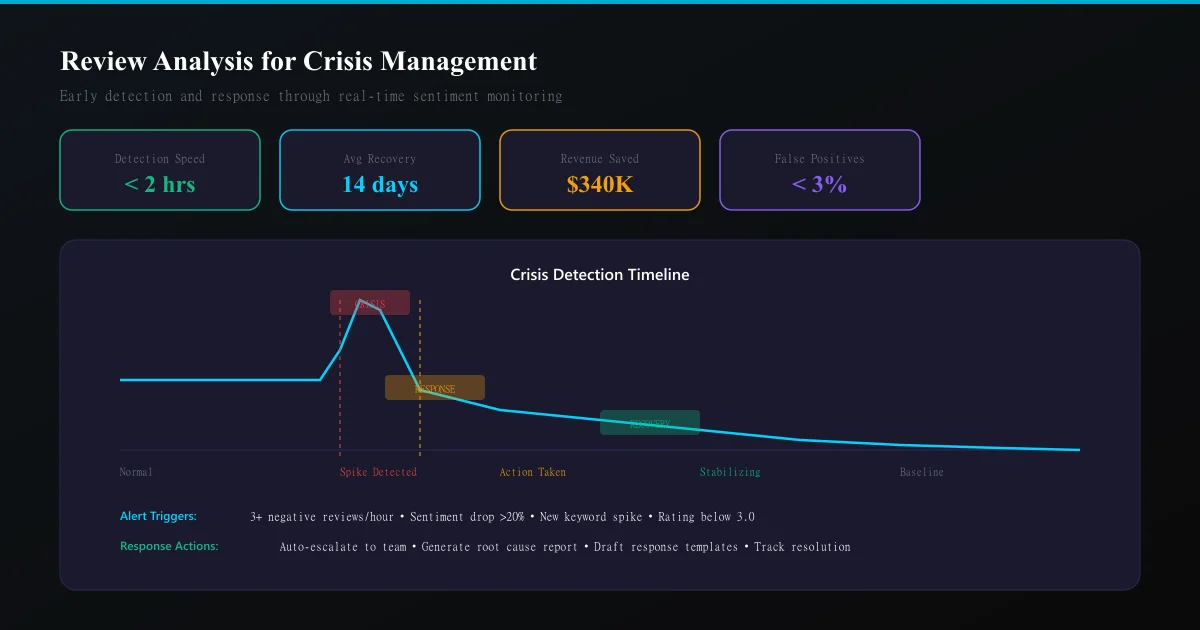
A brand crisis doesn't announce itself politely. It explodes — a viral social media post, a product recall, a data breach, an employee scandal, a CEO's ill-advised comment. And within hours, the review profiles that took years to build start crumbling.
Review bombing during a crisis is now predictable and quantifiable. When a brand enters a PR crisis, negative review volume spikes 500–2000% within the first 48 hours. Many of these reviews come from people who have never used the product — they're expressions of outrage, not customer feedback. But platforms treat them identically to legitimate reviews, and your star rating drops in real time while prospective customers watch.
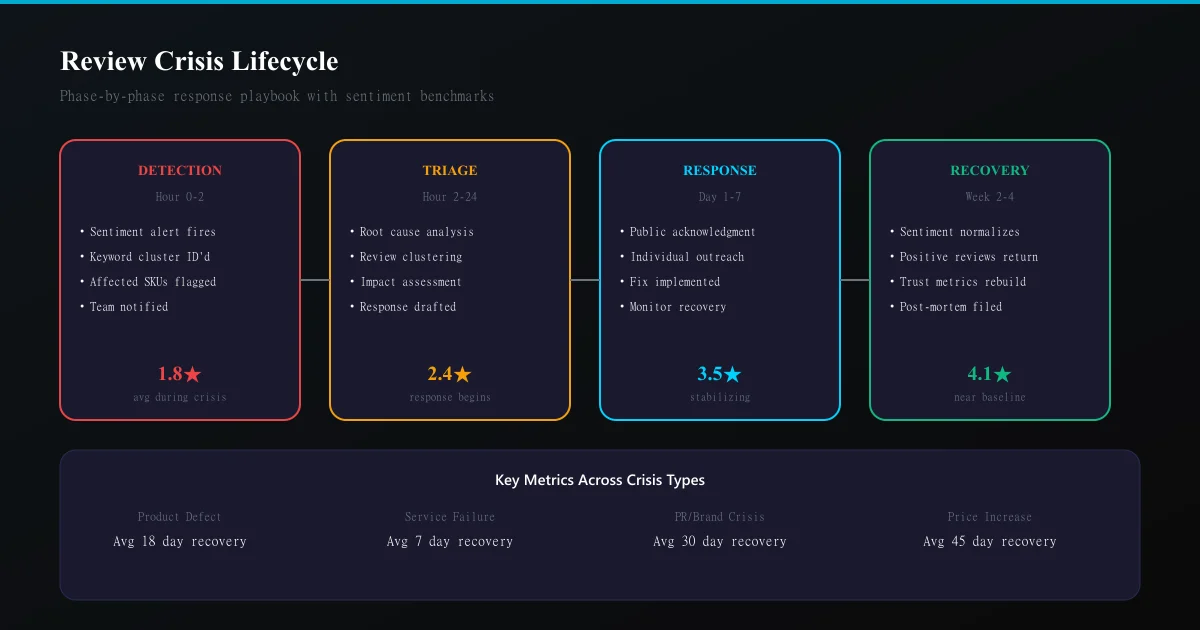
The brands that survive crises with their review profiles intact aren't lucky — they're prepared. They have monitoring systems that detect sentiment shifts before they become avalanches, response protocols that activate within hours, and recovery strategies that systematically rebuild trust through the same review channels that the crisis exploited.
Phase 1: Early Warning — Detecting a Crisis in Review Data
Sentiment Velocity Monitoring
The earliest signal of a brewing crisis often appears in reviews before it hits mainstream media. A product defect, a service failure, or a policy change that angers customers shows up as a sudden sentiment shift in review data hours or days before it trends on social media.
Set up automated alerts for: - Volume spike: Any 24-hour period where new review volume exceeds 3× the trailing 30-day daily average - Sentiment drop: Average sentiment of new reviews dropping below 2.5 stars when trailing average is above 4.0 - Theme emergence: A new complaint theme appearing in 20%+ of reviews within a 48-hour window that wasn't present in the prior month - Cross-platform correlation: The same negative theme appearing simultaneously on Google, Trustpilot, and social media
These alerts should route to your communications team, not just your customer service team. A sentiment shift of this magnitude isn't a support issue — it's a brand issue.
The 4-Hour Window
Research on brand crises shows that the first 4 hours after a trigger event are the most critical for shaping the narrative. After 4 hours, the narrative is set and exponentially harder to influence.
For reviews specifically, the 4-hour window determines whether a complaint stays as isolated negative reviews or becomes a coordinated review-bombing campaign. In the first 4 hours: - 1–2 negative reviews of the same theme = potential coincidence, monitor closely - 5–10 negative reviews of the same theme in 4 hours = emerging pattern, prepare response - 20+ negative reviews of the same theme in 4 hours = active crisis, activate protocol
Distinguishing Customer Feedback From Review Bombing
Not every review spike is a crisis. Seasonal patterns, product launches, and marketing campaigns all generate review volume spikes. The distinguishing characteristics of crisis-driven reviews:
- Reviewer profile signals: New accounts, no purchase verification, no prior review history = likely review bombing. Established accounts with purchase history = likely legitimate customer feedback.
- Language patterns: Reviews using identical phrases, referencing a specific news story, or containing language more characteristic of social media outrage than product feedback = likely coordinated.
- Timing concentration: All reviews posted within a 2–4 hour window rather than distributed over days = likely coordinated.
- Platform concentration: Only appearing on one platform (typically Google, which has the lowest barrier to posting) while other platforms remain normal = likely review bombing.
Use fake review detection techniques to identify inauthentic crisis reviews. The same linguistic signals that flag AI-generated reviews also flag coordinated outrage reviews.
Phase 2: Response — Managing Reviews During a Crisis
The Review Response Protocol
Priority 1: Legitimate customer reviews (first 24 hours) Customers with real purchase history who are expressing genuine concerns related to the crisis deserve immediate, empathetic responses. These are your existing customers — losing their trust has real revenue impact.
Response template for legitimate crisis reviews: - Acknowledge the concern specifically (don't use generic language) - State what you know and what you're doing - Don't make promises you can't keep - Provide a direct contact channel for personal follow-up - Commit to an update timeline
Priority 2: Coordinated review bombs Reviews from non-customers that are clearly part of a coordinated campaign should be: - Flagged for platform review — report as policy-violating (most platforms have expedited review for crisis situations) - Not individually responded to — responding to review-bomb reviews amplifies the attacker's reach - Documented — compile evidence (account creation dates, identical language, no purchase verification) for platform abuse reports
Priority 3: Media/influencer reviews Reviews or public statements from journalists, influencers, or public figures carry outsized impact. These require corporate-level response, not customer-service-level response. Escalate to your communications team.
What NOT to Do During a Review Crisis
Don't delete or hide reviews. Even if you have the technical ability to remove reviews (on owned platforms), doing so during a crisis creates a secondary scandal ("Brand X is silencing critics"). The Streisand effect is real and devastating.
Don't respond defensively. "Actually, you're wrong because..." responses to crisis reviews drive more negative attention than silence. Acknowledge, empathise, commit to action.
Don't flood with fake positives. The temptation to counter negative reviews with purchased positive reviews is strong and always catastrophic. Review manipulation during a crisis is the fastest path to a secondary crisis that's worse than the original.
Don't go silent. Some brands freeze during crises and stop responding to all reviews. This signals abandonment to legitimate customers and emboldens attackers. Maintain your response rhythm for legitimate reviews.
Phase 3: Recovery — Rebuilding Your Review Profile
The Recovery Timeline
Review profile recovery follows a predictable pattern: - Week 1–2: Active crisis. Negative volume spike. Rating drops. - Week 3–4: Crisis fades from news. Negative volume normalises. But rating remains depressed because the crisis reviews are now part of your average. - Week 5–8: Recovery period. New organic reviews from satisfied customers begin to dilute the crisis reviews. Rating gradually climbs. - Week 9–12: Stabilisation. Rating approaches (but may not fully return to) pre-crisis levels.
The total recovery time depends on your pre-crisis review velocity. A business that generates 100 reviews/month recovers faster than one generating 10/month, because new positive reviews dilute the crisis negatives faster.
Accelerating Recovery (Ethically)
You cannot buy or manufacture your way out of a review crisis. But you can ethically accelerate recovery:
See What Your Reviews Really Say
Paste any product URL and get an AI-powered SWOT analysis in under 60 seconds.
Try It Free →Increase review solicitation from recent customers. After the crisis resolves, send review requests to customers who've had positive recent experiences. Don't specifically ask for positive reviews — ask all recent customers for honest feedback. The natural positivity rate of satisfied customers will generate the positive reviews you need. This is review generation, not review manipulation.
Resolve the underlying issue publicly. If the crisis was caused by a product defect, service failure, or policy change, fixing the root cause and communicating the fix publicly encourages updated reviews and builds new positive sentiment. Some platforms (Google, Trustpilot) allow reviewers to update their reviews — a customer who left a 1-star review during the crisis might update to 4 stars after seeing the resolution.
Leverage your response history. During the crisis, your thoughtful, empathetic responses to legitimate reviews are now visible public evidence that you handle problems well. Prospective customers who read the crisis reviews will also read your responses. A brand that handled a crisis gracefully in its review responses can actually emerge with stronger perceived trustworthiness than before the crisis.
Measuring Recovery
Track these metrics weekly during recovery:
| Metric | Crisis Low | Recovery Target | Pre-Crisis Baseline |
|---|---|---|---|
| Average rating (last 30 days) | ? | Within 0.3 of baseline | Known |
| Negative review % (last 30 days) | Spiked | Within 5% of baseline | Known |
| Review volume (weekly) | Spiked then dropped | Return to normal velocity | Known |
| Response rate | Should be 100% during crisis | Return to standard | Known |
| Sentiment score (from analysis) | Dropped | Within 10% of baseline | Known |
When all five metrics return to within acceptable range of pre-crisis baselines, the recovery is complete.
Crisis Prevention Through Review Monitoring
The best crisis management is crisis prevention. Systematic review sentiment tracking surfaces problems before they become crises:
Emerging complaint clusters. When a new complaint theme appears in 10% of reviews over two weeks, it's an emerging issue. Address it at 10% and it stays a manageable problem. Ignore it until it reaches 30% and you have a potential crisis.
Staff/location-specific patterns. A single employee, location, or product generating disproportionate negative reviews is a containable issue — until it goes viral. Regular review analysis catches these patterns early.
Competitive attack detection. Sometimes "crisis" reviews are actually competitor sabotage — coordinated negative reviews from accounts connected to a competitor. Review analysis that cross-references reviewer profiles against competitor connections can detect this before it damages your rating.
Industry-Specific Crisis Scenarios
Food & Beverage: Contamination or Allergen Issues
A food safety issue generates the most emotionally intense review crises because health is at stake. Reviews will describe illness symptoms, demand recalls, and express fear. Restaurant review analysis and pet food review analysis are particularly sensitive to these triggers.
Specific actions: Respond to every health-related review with a crisis-specific response that includes your food safety hotline. Never dispute a health claim publicly. Report the review pattern to your quality control team immediately.
Tech/SaaS: Data Breach or Outage
A data breach crisis generates reviews focused on trust violation and security concern. Unlike a product quality issue, a data breach review crisis can come from users who haven't been directly affected but fear they might be.
Specific actions: Your review response must include specific information about what happened, what data was affected, and what you're doing to prevent recurrence. Vague "we take security seriously" responses during a data breach crisis are worse than silence.
Retail/E-commerce: Shipping or Pricing Scandal
A viral pricing error, mass shipping failure, or deceptive marketing exposure generates review spikes focused on fairness and integrity.
Specific actions: If the issue involves money (overcharging, bait-and-switch), the only effective review response includes a specific remedy (refund, credit, discount). Apology without financial remedy during a pricing/shipping crisis reads as empty.
Building Your Crisis Playbook
Every business should have a pre-written review crisis playbook:
- Monitoring triggers — what alert thresholds activate the crisis protocol
- Escalation chain — who gets notified at each severity level
- Response templates — pre-approved language for different crisis types (adapt, don't copy verbatim)
- Platform contacts — direct contacts at Google, Trustpilot, Yelp for expedited abuse review
- Recovery checklist — week-by-week actions for the 8-week recovery period
- Post-mortem template — how to analyse what happened, what worked, and what to improve
Frequently Asked Questions
Can I get review-bomb reviews removed? Yes — if they violate platform policies (no purchase verification, identical language suggesting coordination, personal attacks). Google, Trustpilot, and Yelp all have mechanisms for reporting coordinated abuse. Response time varies: 24–72 hours for Google, 1–2 weeks for others. Document the evidence clearly.
How much does a crisis typically drop a star rating? For a significant crisis (national news coverage, viral social moment): 0.3–0.8 stars on platforms with high review volume, 1.0–2.0 stars on platforms with low review volume (where each review has more weight). The drop depends on pre-crisis review volume — high-volume profiles are more resilient.
Should I pause my review solicitation during a crisis? No — continue sending review requests to customers who had positive experiences. You need the positive review flow to begin diluting crisis reviews as early as possible. But don't increase solicitation volume suddenly (it looks reactive) and don't target specific customers for positive reviews (it's review gating).
How long does it take to recover from a review crisis? 6–12 weeks for a typical crisis with active recovery management. 3–6 months for severe crises (data breaches, health scares, legal issues). Without active recovery management, some brands never fully recover — the crisis reviews permanently depress their rating.
Can review analysis predict a crisis before it happens? Not the triggering event itself — but review analysis can identify vulnerability. If your reviews already show emerging dissatisfaction around a specific theme (e.g., "data privacy concerns" mentions increasing), you're vulnerable to a crisis around that theme. Address the underlying issue proactively, and you remove the fuel that a crisis would ignite.
Ready to try AI-powered review analysis?
Get 2 free SWOT reports per month. No credit card required.
Start FreeRelated Articles
Review bombing can destroy your rating overnight. Learn how to detect coordinated fake review attacks, distinguish them from legitimate feedback, report violations to Google, Amazon, Yelp, and Trustpilot, respond strategically, pursue legal options, and recover your rating.
Discord Community Sentiment Analysis: Mining Member Feedback From Private CommunitiesDiscord communities are invisible to traditional review platforms. Learn how to systematically extract and analyze member sentiment from channels to detect engagement churn, identify friction points, and drive community growth.
Luxury Brand Review Analysis: Understanding High-End Customer Expectations and FeedbackLuxury brands operate with different customer expectations. Learn how to analyze reviews on specialty platforms, separate outcome from process feedback, and detect quality deterioration in high-margin segments.